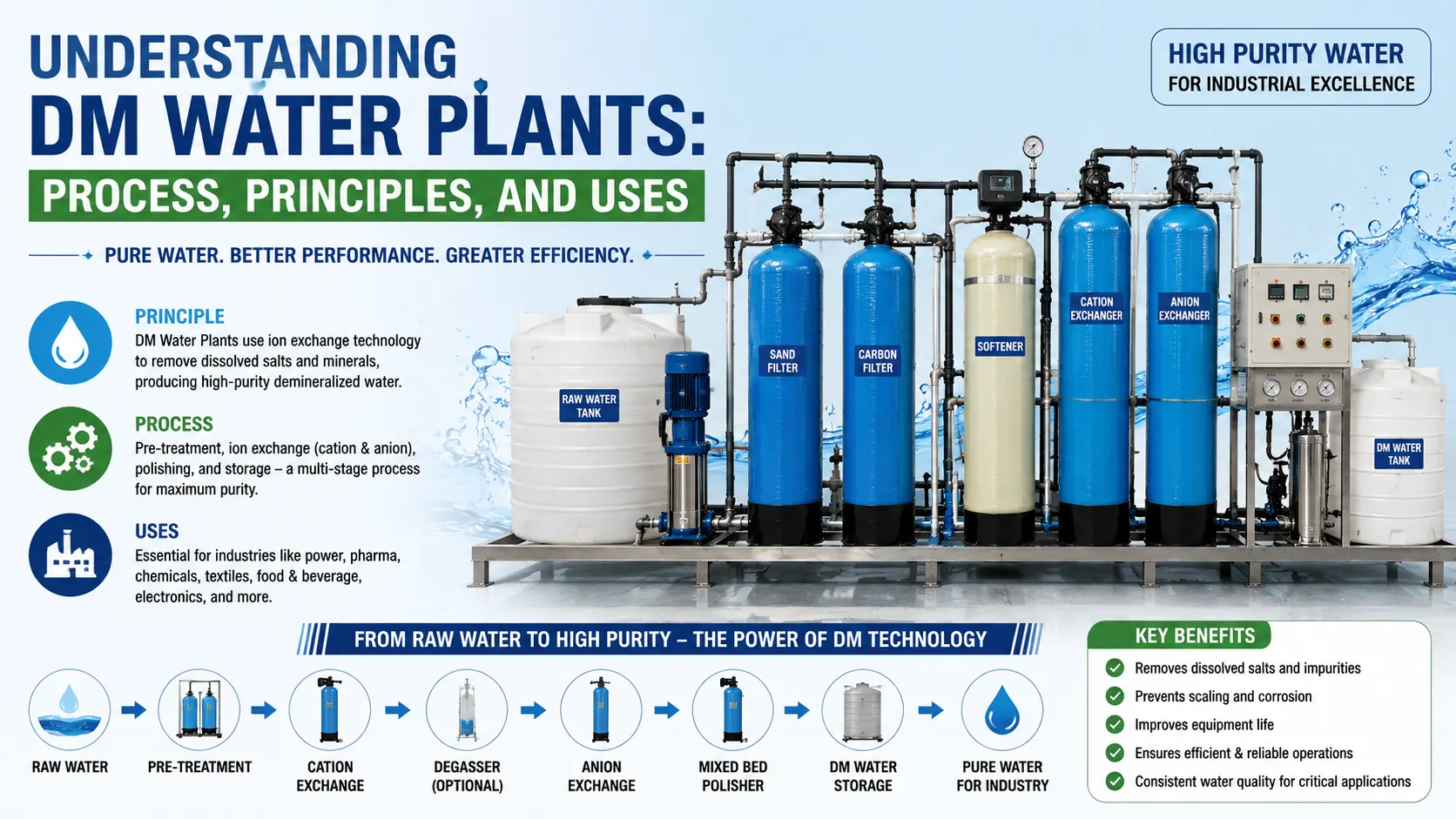
DM Water Plant Explained: Working Principle, Process & Applications
Water quality plays a crucial role in industrial operations, especially in sectors where mineral-free water is essential for production processes. Industries such as power generation, pharmaceuticals, chemicals, food processing, textiles, and electronics require highly purified water to ensure operational efficiency and product quality. This is where DM Water Plants (Demineralized Water Plants) become an essential part of the water treatment process.
DM Water Plants are designed to remove dissolved minerals, salts, and impurities from water, producing high-purity water suitable for various industrial applications. In this blog, we will explore the working principles, treatment process, benefits, and applications of DM Water Plants.
What is a DM Water Plant?
A DM Water Plant, also known as a Demineralization Plant, is a water treatment system that removes dissolved ionic impurities such as calcium, magnesium, sodium, chloride, sulfate, and other minerals from raw water. The process produces demineralized water with very low conductivity and high purity.
The treated water is widely used in industries where mineral-free water is required to prevent scaling, corrosion, and contamination in equipment and manufacturing processes.
Principle of DM Water Plant
The basic principle of a DM Water Plant is Ion Exchange Technology. The system uses specialized ion exchange resins to remove positively charged ions (cations) and negatively charged ions (anions) from water.
During the treatment process:
-
Cation exchange resin removes calcium, magnesium, sodium, and other positive ions.
-
Anion exchange resin removes chloride, sulfate, nitrate, and other negative ions.
-
The result is highly purified water with minimal dissolved solids.
This process significantly reduces Total Dissolved Solids (TDS) and improves water quality for industrial applications.
DM Water Treatment Process
1. Raw Water Collection
The treatment process begins with collecting raw water from borewells, municipal supplies, rivers, or other sources.
2. Pre-Treatment
Before entering the DM plant, water passes through pre-treatment systems such as:
-
Sand Filters
-
Activated Carbon Filters
-
Water Softeners
-
Micron Cartridge Filters
These systems remove suspended particles, organic matter, and hardness that may affect resin performance.
3. Cation Exchange Unit
The water enters the cation exchanger where dissolved positive ions are replaced with hydrogen ions.
4. Degasser Unit (Optional)
Some DM systems include a degasser tower to remove dissolved carbon dioxide formed during the cation exchange process.
5. Anion Exchange Unit
Water then passes through the anion exchanger where dissolved negative ions are replaced with hydroxyl ions.
6. Mixed Bed Polisher
For applications requiring ultra-pure water, a mixed bed unit further polishes the water to achieve extremely low conductivity.
7. Storage and Distribution
The treated DM water is stored in dedicated tanks and supplied to industrial processes as required.
Key Components of a DM Water Plant
-
Raw Water Storage Tank
-
Pressure Sand Filter
-
Activated Carbon Filter
-
Water Softener
-
Cation Exchange Vessel
-
Anion Exchange Vessel
-
Mixed Bed Unit
-
Chemical Dosing System
-
DM Water Storage Tank
-
Pumps and Control Panels
Benefits of DM Water Plants
High Water Purity
DM plants produce mineral-free water suitable for critical industrial applications.
Prevents Scaling
Removal of hardness minerals prevents scale formation in boilers, pipelines, and heat exchangers.
Reduces Corrosion
Low mineral content minimizes corrosion in industrial equipment.
Improved Process Efficiency
High-quality water enhances production efficiency and equipment performance.
Lower Maintenance Costs
Reduced scaling and corrosion lead to lower maintenance expenses and longer equipment life.
Reliable Operation
DM systems provide consistent water quality for continuous industrial operations.
Applications of DM Water Plants
Power Plants
Used as boiler feed water to prevent scaling and improve efficiency.
Pharmaceutical Industry
Required for manufacturing medicines and maintaining product quality.
Chemical Industry
Used in chemical processing and formulation applications.
Food and Beverage Industry
Provides purified water for production processes.
Textile Industry
Used in dyeing and finishing operations where mineral-free water is required.
Electronics Industry
Essential for manufacturing electronic components and circuit boards.
Laboratories
Provides high-purity water for testing and research activities.
Why Industries Prefer DM Water Plants
Industrial equipment and production systems often require water with minimal mineral content. Even small amounts of dissolved salts can cause scaling, corrosion, and process inefficiencies. DM Water Plants provide a dependable solution by delivering consistently purified water that improves productivity and equipment lifespan.
Searching Best DM Water Plant Suppliers With E India Connect
Businesses looking for reliable DM Water Plant manufacturers, suppliers, and water treatment solution providers can explore E India Connect, a leading B2B portal and marketplace. The platform connects buyers with verified manufacturers, exporters, suppliers, and service providers across various industrial sectors.
E India Connect helps industries compare products, explore supplier profiles, request quotations, and identify suitable water treatment solutions according to their specific requirements.
Conclusion
DM Water Plants play a vital role in producing high-purity water for industrial applications. By removing dissolved minerals and impurities, these systems help prevent scaling, reduce corrosion, improve process efficiency, and extend equipment life.
As industries continue to demand better water quality and operational efficiency, DM Water Plants remain one of the most effective solutions for reliable water purification. Businesses seeking trusted suppliers and water treatment equipment can leverage E India Connect to connect with manufacturers and explore a wide range of industrial water treatment solutions.