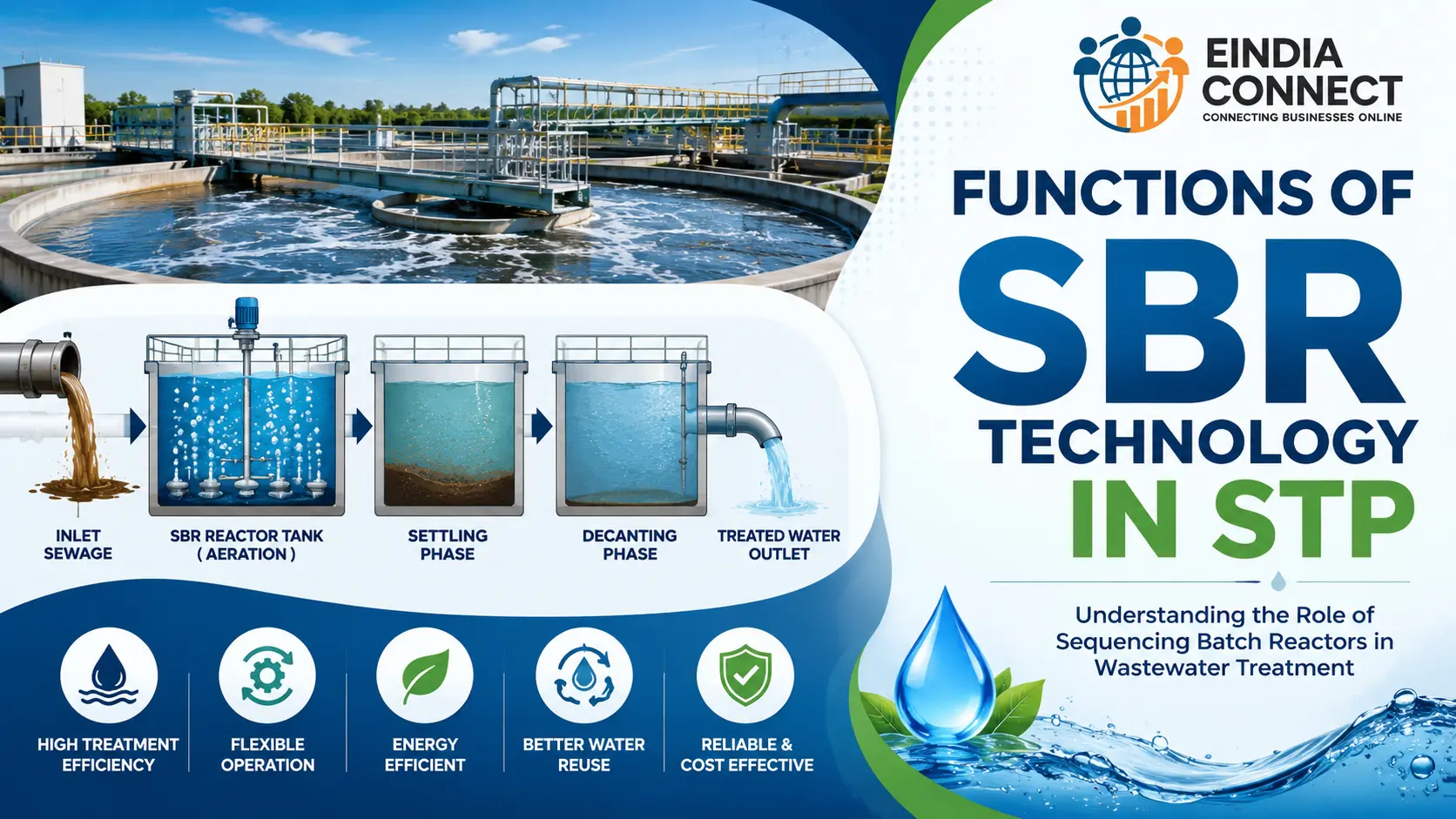
Functions of SBR Technology in STP: A Complete Guide
With the increasing emphasis placed on sustainable sewage management within the realms of industries, commercial setups, housing projects, and urban areas, STPs have become an important part of infrastructure. From the multitude of sewage treatment technologies that are currently employed, SBR technology stands out as a highly efficient system.
For businesses looking to invest in sewage treatment solutions or understand modern wastewater treatment systems, it is important to know the role and functions of SBR technology in STPs. In this article, we will discuss the sbr full form, working process, advantages, functions, and applications of sbr stp systems.
What Is SBR Technology?
The SBR full form is Sequencing Batch Reactor. It is an advanced biological wastewater treatment process that treats sewage in batches rather than in a continuous flow.
In simple terms, SBR technology combines several treatment stages such as aeration, settling, and decanting within a single reactor tank. This makes the process highly efficient while reducing the need for multiple treatment tanks.
Today, SBR systems are widely used in residential societies, hotels, hospitals, commercial buildings, educational institutions, industries, and municipal wastewater treatment projects.
SBR Full Form in STP
SBR = Sequencing Batch Reactor
Therefore, when discussing an STP, the sbr full form stp refers to a treatment process where wastewater is treated in a reactor through a sequence of controlled cycles.
The technology is considered one of the most effective biological treatment methods for removing organic pollutants, suspended solids, and nutrients from sewage.
What Is an SBR STP?
An SBR STP is a sewage treatment plant that uses Sequencing Batch Reactor technology to treat wastewater. Unlike conventional treatment systems that require separate tanks for aeration and clarification, SBR technology performs multiple treatment functions within a single reactor basin. This integrated approach helps reduce installation space, operational complexity, and infrastructure costs.
Working Principle of SBR Technology
The efficiency of SBR technology comes from its ability to perform wastewater treatment through a sequence of controlled treatment stages.
The process typically consists of five major phases:
1. Fill Phase
During this stage, untreated sewage enters the reactor tank. The wastewater mixes with activated sludge containing beneficial microorganisms that help break down organic matter.
2. Aeration Phase
Air is supplied through diffusers or aerators.
During this stage:
- Microorganisms consume organic pollutants.
- Biological oxidation occurs.
- Harmful contaminants are reduced.
- Wastewater quality improves significantly.
This phase plays a critical role in the overall performance of the sbr stp system.
3. Settling Phase
After aeration stops, the biomass settles at the bottom of the reactor. This process separates treated water from suspended solids without requiring a separate clarifier tank.
4. Decanting Phase
The clear treated water is removed from the upper portion of the tank through a decanter system. The treated water can then be reused or discharged according to environmental regulations.
5. Idle Phase
The reactor prepares for the next treatment cycle. Additional sludge management and process adjustments may also be carried out during this stage.
Major Functions of SBR Technology in STP
Effective Removal of Organic Pollutants
One of the primary functions of SBR technology is the removal of biodegradable organic matter from wastewater.
The biological treatment process significantly reduces BOD (Biochemical Oxygen Demand) and COD (Chemical Oxygen Demand) levels.
Suspended Solids Reduction
The settling phase helps separate suspended solids from treated water, improving effluent quality.
Nutrient Removal
Modern SBR systems are capable of removing nutrients such as:
- Nitrogen
- Phosphorus
This helps prevent water pollution and eutrophication in receiving water bodies.
High-Quality Treated Water Production
An SBR STP produces treated water suitable for various non-potable reuse applications, including:
- Gardening
- Landscaping
- Toilet flushing
- Cooling towers
- Construction activities
Space Optimization
Because multiple treatment functions occur within a single reactor, SBR plants require less space compared to many conventional STP technologies.
Process Flexibility
SBR technology can easily adapt to fluctuations in wastewater flow and pollutant load. This makes it highly suitable for commercial and residential projects with varying sewage generation patterns.
Advantages of SBR Technology
- Compact Design- The integrated treatment process reduces the need for multiple tanks and large infrastructure.
- Lower Footprint Requirement- SBR systems occupy less space compared to traditional treatment methods.
- Superior Effluent Quality- The treated water produced by SBR technology often meets stringent environmental standards.
- Reduced Operational Costs- Automation and simplified process control help lower operating expenses.
- Easy Automation- Most modern SBR STP systems are equipped with automated controls for efficient operation.
- Better Treatment Efficiency- The batch treatment process ensures excellent removal of pollutants and contaminants.
Applications of SBR STP Systems
Due to its versatility, SBR technology is used across numerous sectors.
- Residential Complexes- Large housing societies use SBR-based STPs for sewage treatment and water reuse.
- Hotels and Resorts- Hospitality facilities rely on SBR plants to manage wastewater efficiently while supporting sustainability goals.
- Hospitals- Hospitals generate significant wastewater volumes that require effective treatment before disposal or reuse.
- Commercial Buildings- Office complexes and shopping centers commonly install SBR STP systems to meet environmental compliance requirements.
- Educational Institutions- Schools, colleges, and universities use SBR plants for wastewater treatment and water conservation.
- Industrial Facilities- Many industries utilize SBR systems to treat domestic wastewater generated within factory premises.
- Municipal Projects- Municipal authorities often implement large-scale SBR plants for urban wastewater management.
SBR Technology vs Conventional STP Systems
Compared with conventional activated sludge processes, SBR technology offers several advantages:
| Feature | SBR Technology | Conventional STP |
|---|---|---|
| Space Requirement | Low | Higher |
| Number of Tanks | Fewer | Multiple |
| Automation | High | Moderate |
| Effluent Quality | Excellent | Good |
| Flexibility | High | Moderate |
| Maintenance | Easier | More Complex |
These benefits make SBR one of the preferred technologies for modern sewage treatment projects.
Why Businesses Prefer SBR Technology
For businesses and infrastructure developers, wastewater treatment is not only an environmental requirement but also an operational necessity.
Companies often choose SBR technology because it provides:
- Reliable performance
- Reduced operating costs
- Better water reuse opportunities
- Compliance with environmental regulations
- Efficient use of available space
- Long-term sustainability benefits
These factors make SBR-based treatment systems a practical investment for organizations of all sizes.
Future of SBR Technology in Wastewater Treatment
As water scarcity becomes a growing concern worldwide, advanced treatment technologies will continue to gain importance.
Future developments in SBR technology are expected to focus on:
- Smart monitoring systems
- IoT-based automation
- Energy-efficient aeration
- Advanced nutrient removal
- Enhanced water reuse capabilities
These innovations will further improve treatment efficiency and sustainability.
Conclusion
Understanding the sbr full form, sbr full form stp, and sbr full form in stp is essential for anyone involved in wastewater treatment projects. SBR technology has emerged as one of the most efficient and reliable methods for sewage treatment due to its compact design, superior treatment performance, and operational flexibility.
The various functions of an SBR STP, including pollutant removal, nutrient reduction, suspended solids separation, and water reuse support, make it an ideal solution for residential, commercial, industrial, and municipal applications. As businesses increasingly prioritize sustainability and environmental compliance, SBR technology will continue to play a vital role in modern wastewater management systems.