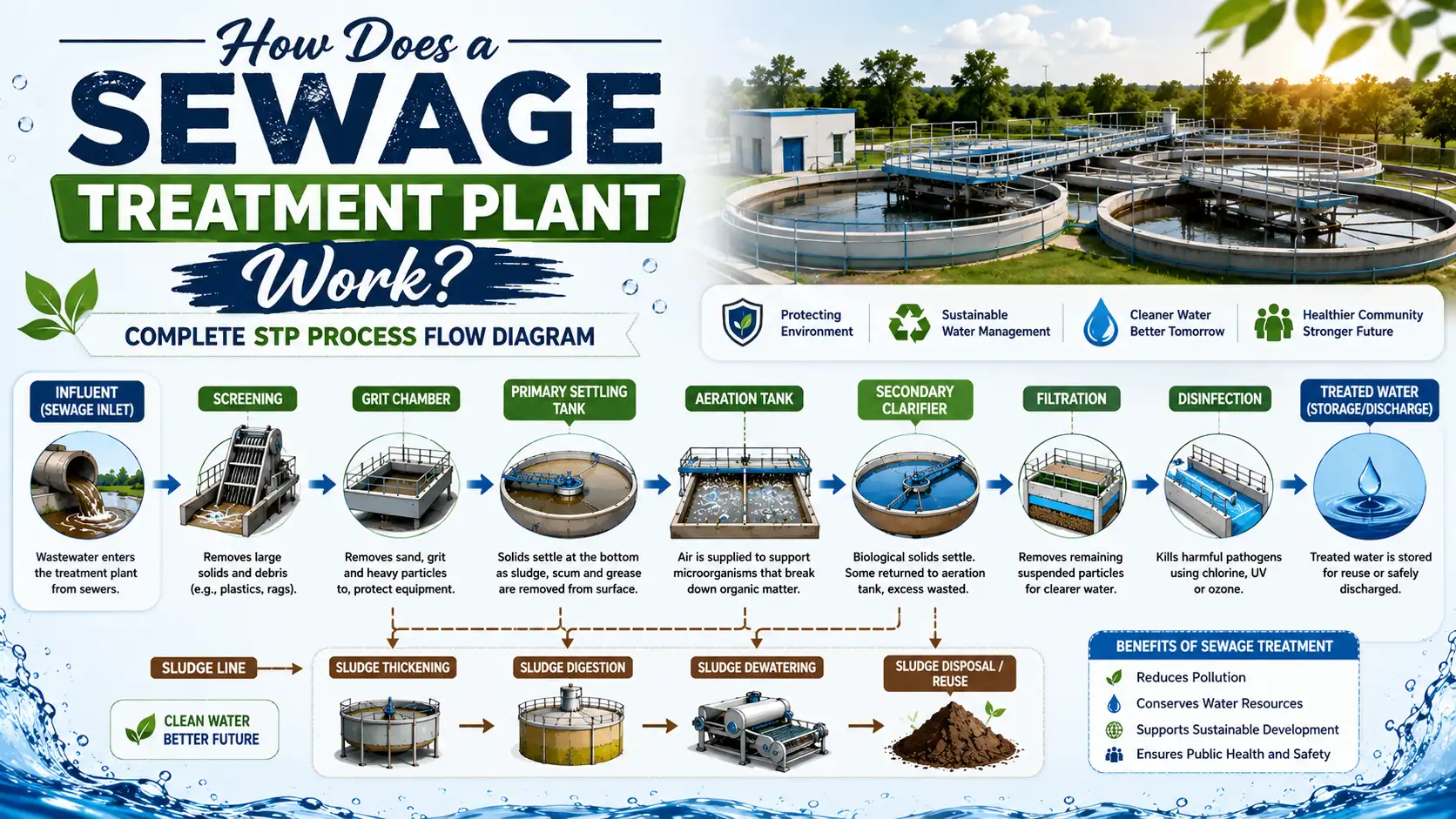
How do Sewage Treatment Plants Work Flow Diagrams?
Sewage treatment plants play a crucial role in protecting public health and the environment by treating wastewater before it is released back into nature or reused. Understanding the treatment process becomes much easier when presented visually through a sewage treatment plant diagram. Flow diagrams help explain how wastewater moves through different treatment stages, from the collection of sewage to the final discharge of treated water.
For businesses, industries, municipalities, and environmental professionals, understanding the flowchart sewage treatment plant process is essential for effective wastewater management. As a leading B2B Portal and Marketplace, E India Connect offers and provides a platform where buyers and suppliers can connect for sewage treatment solutions, equipment, and related services.
What is a Sewage Treatment Plant?
A Sewage Treatment Plant (STP) is a facility designed to remove contaminants, organic matter, suspended solids, and harmful microorganisms from wastewater. The objective is to convert polluted sewage into treated water that can be safely discharged or reused for various applications.
A well-designed stp plant diagram helps users understand the sequence of operations and the role of each treatment stage. These diagrams are commonly used by engineers, students, facility managers, and environmental consultants.
Importance of Sewage Treatment Plant Flow Diagrams
A visual representation of the treatment process simplifies complex operations and helps users understand how wastewater is treated.
Benefits of using a sewage treatment plant diagram include:
- Easy understanding of treatment stages
- Better operational planning
- Improved maintenance management
- Simplified employee training
- Enhanced process monitoring
- Support for educational purposes
Many industries use an easy sewage treatment plant diagram to explain treatment processes to staff, stakeholders, and regulatory authorities.
Flowchart Sewage Treatment Plant Process
The flowchart sewage treatment plant process typically follows a sequence of treatment stages designed to remove various contaminants from wastewater.
1. Collection of Sewage
The process begins when wastewater from residential, commercial, and industrial sources enters the sewage collection system. The sewage is transported through pipelines to the treatment facility.
2. Screening Process
The first stage in the diagram of sewage treatment plant involves screening. Large objects such as plastics, rags, sticks, and debris are removed using coarse and fine screens.
This step protects pumps and equipment from damage and prevents blockages within the treatment system.
3. Grit Removal Chamber
After screening, wastewater enters the grit chamber where heavier particles such as sand, gravel, and small stones settle to the bottom.
Removing grit helps reduce wear and tear on mechanical equipment and improves treatment efficiency.
4. Primary Sedimentation Tank
In this stage, wastewater is allowed to remain in a sedimentation tank where heavier suspended solids settle at the bottom while oils and grease float to the surface.
The settled solids form sludge, which is collected for further treatment.
A standard sewage treatment plant diagram often highlights this step as the primary treatment stage.
5. Aeration Tank
The aeration tank is one of the most important components shown in an easy sewage treatment plant diagram.
Air is introduced into the wastewater to promote the growth of beneficial microorganisms. These microorganisms consume organic pollutants and break down harmful substances present in sewage.
6. Secondary Clarifier
After aeration, the wastewater enters a secondary clarifier where biological solids settle to the bottom. Part of the settled biomass is returned to the aeration tank to maintain microbial activity, while excess sludge is removed for further processing.
This stage is a key component in any stp plant diagram because it separates treated water from biological solids.
7. Filtration Process
In advanced treatment systems, treated water may pass through filtration units to remove fine particles and residual impurities.
These systems improve water quality and prepare it for reuse or discharge.
8. Disinfection
The next stage shown in a diagram of sewage treatment plant is disinfection.
Methods such as chlorination, ultraviolet (UV) treatment, or ozone treatment are used to eliminate harmful bacteria, viruses, and pathogens.
This step ensures the treated water is safe for release into the environment.
9. Treated Water Storage
After disinfection, the treated water is collected in storage tanks for reuse or discharge.
Depending on the application, treated water may be used for:
- Landscape irrigation
- Industrial cooling
- Toilet flushing
- Gardening
- Construction activities
Sewage Treatment Plant Diagram
An easy sewage treatment plant diagram is designed to present the entire process in a simple and understandable format.
The typical flow sequence appears as:
Collection Tank → Screening → Grit Chamber → Primary Settling Tank → Aeration Tank → Secondary Clarifier → Filtration → Disinfection → Treated Water Storage
This simplified representation helps students, operators, and decision-makers understand wastewater treatment without requiring extensive technical knowledge.
Understanding wastewater treatment becomes much easier through a well-structured sewage treatment plant diagram. Whether you are studying the flowchart sewage treatment plant process, reviewing an easy sewage treatment plant diagram, or analyzing a detailed diagram of sewage treatment plant, flow diagrams provide a clear picture of how wastewater is transformed into reusable and environmentally safe water.
With growing environmental awareness and stricter regulations, sewage treatment systems are becoming increasingly important. E India Connect provides a valuable B2B Portal and Marketplace where businesses can discover reliable sewage treatment solutions and connect with industry-leading suppliers.