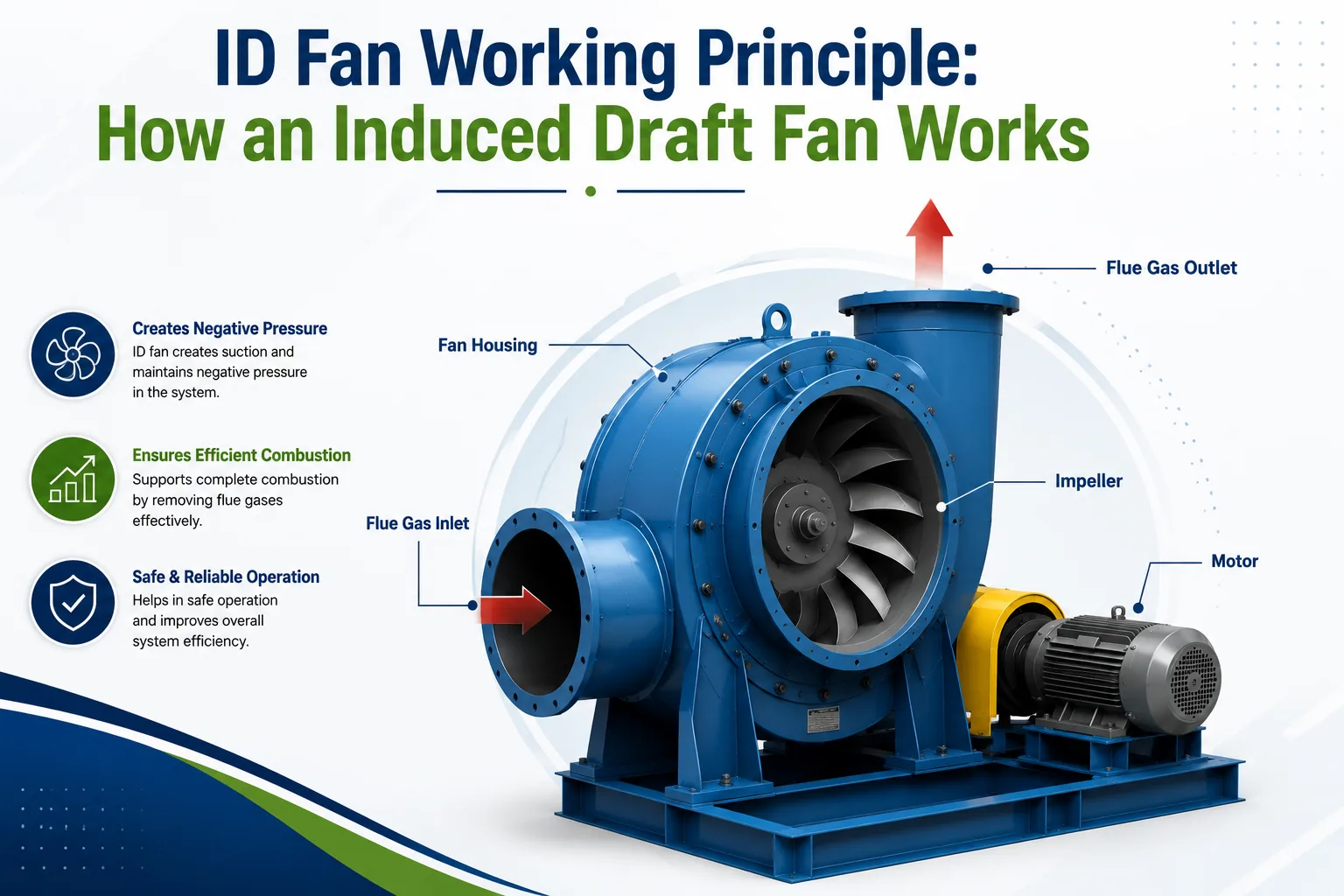
ID Fan Working Principle: How an Induced Draft Fan Works
An Induced Draft Fan (ID Fan) is a critical component in industrial ventilation, boiler systems, power plants, cement plants, and manufacturing facilities. It is primarily used to remove flue gases, smoke, dust-laden air, and combustion gases from furnaces, boilers, and industrial processes while maintaining the required negative pressure within the system.
ID fans play an essential role in ensuring efficient combustion, safe operation, and environmental compliance. Understanding the working principle of an ID fan helps industries optimize system performance and improve operational efficiency.
What is an ID Fan?
An Induced Draft Fan is a mechanical device installed at the outlet side of a boiler, furnace, kiln, or process system. Its main function is to draw flue gases through the combustion chamber and discharge them safely through a chimney or stack.
Unlike Forced Draft (FD) Fans that push fresh air into the combustion chamber, ID fans pull gases out of the system, creating a negative pressure environment that supports efficient combustion.
ID Fan Working Principle
The working principle of an ID fan is based on creating a pressure difference that induces the flow of gases through the system.
Step-by-Step Working Process
- Fuel is burned inside the boiler, furnace, or combustion chamber.
- Combustion produces hot flue gases and exhaust emissions.
- The ID fan, installed near the outlet side, rotates its impeller at high speed.
- The rotating impeller creates a suction effect.
- This suction generates negative pressure inside the combustion chamber.
- Flue gases are drawn through ducts, dust collectors, or pollution control equipment.
- The gases are then discharged through the chimney into the atmosphere.
This continuous process ensures smooth airflow and efficient removal of combustion gases.
Simple Flow Diagram
Boiler/Furnace
│
▼
Flue Gases
│
▼
Dust Collector
│
▼
ID Fan
│
▼
Chimney
│
▼
Atmosphere
Main Components of an ID Fan
Impeller
The impeller is the rotating component responsible for generating airflow and suction.
Fan Housing
The housing encloses the impeller and directs airflow efficiently.
Motor
Provides power to rotate the impeller.
Shaft
Transfers power from the motor to the impeller.
Bearings
Support smooth rotation and reduce friction.
Dampers
Control airflow volume and system pressure.
Functions of an ID Fan
- Removes flue gases from boilers and furnaces
- Maintains negative pressure in combustion chambers
- Supports efficient combustion
- Improves heat transfer efficiency
- Controls airflow within industrial systems
- Assists pollution control equipment operation
- Enhances plant safety and environmental compliance
Applications of ID Fans
Thermal Power Plants
Used to extract combustion gases from boilers and direct them through emission control systems.
Cement Plants
Help remove hot gases generated during clinker production.
Steel Industries
Support furnace ventilation and exhaust gas handling.
Chemical Industries
Assist in removing process gases and maintaining safe operating conditions.
Paper Mills
Used in boiler and drying systems.
Sugar Industries
Support efficient boiler operations during sugar production.
Textile Industries
Used for ventilation and process air management.
Advantages of ID Fans
Improved Combustion Efficiency
Maintaining proper airflow helps achieve complete fuel combustion.
Enhanced Safety
Prevents accumulation of harmful gases inside industrial equipment.
Better Environmental Compliance
Facilitates efficient operation of pollution control systems.
Continuous Operation
Provides reliable exhaust gas removal for uninterrupted production.
Energy Efficiency
Modern ID fans are designed to deliver high airflow with optimized power consumption.
Reduced Maintenance Costs
Robust construction ensures long service life and dependable performance.
Difference Between ID Fan and FD Fan
|
Feature |
ID Fan |
FD Fan |
|
Function |
Pulls gases out |
Pushes fresh air in |
|
Location |
Outlet side |
Inlet side |
|
Pressure Created |
Negative pressure |
Positive pressure |
|
Purpose |
Exhaust gas removal |
Combustion air supply |
|
Application |
Boilers, furnaces |
Boilers, burners |
Both fans work together in many industrial systems to maintain balanced airflow and efficient combustion.
Factors Affecting ID Fan Performance
Several factors influence the efficiency of an ID fan:
- Fan speed
- Impeller design
- System resistance
- Gas temperature
- Duct layout
- Maintenance condition
- Motor efficiency
Regular monitoring helps maintain optimal performance.
Maintenance Tips for ID Fans
To ensure reliable operation:
- Inspect bearings regularly.
- Check impeller condition.
- Monitor vibration levels.
- Lubricate moving components.
- Clean dust deposits from fan blades.
- Inspect motor alignment.
- Verify damper operation.
Preventive maintenance helps avoid unexpected breakdowns and extends equipment life.
Importance of ID Fans in Modern Industries
Industrial operations depend heavily on effective airflow management. ID fans ensure safe removal of combustion gases, improve production efficiency, and support environmental protection efforts. Their role is especially important in industries that operate boilers, furnaces, kilns, and high-temperature processing equipment.
Finding Industrial Equipment Suppliers
Industries looking for high-quality ID fans, industrial blowers, ventilation systems, and related equipment can explore trusted suppliers through E India Connect, a leading B2B portal and marketplace. The platform connects buyers with manufacturers, exporters, and suppliers across various industrial sectors, making it easier to source reliable industrial equipment and solutions.
Conclusion
An ID Fan is an essential industrial component that creates negative pressure to remove flue gases and exhaust emissions from boilers, furnaces, and process systems. By ensuring efficient airflow, improved combustion, and safe operation, ID fans contribute significantly to industrial productivity and environmental compliance. Understanding the working principle and applications of ID fans helps industries select the right equipment and maintain efficient plant operations.