Single Screw Extruder Diagram: Parts, Working & Applications Guide
Extrusion technology holds great significance in modern manufacturing industries, especially in terms of plastics, polymers, rubber, food manufacturing, and cables manufacturing processes. From all the different varieties of extrusion equipment available in the market, the single screw extruder is among those that enjoy wide popularity because of its simplicity in design and effective performance.
Irrespective of your profession, be it a manufacturing firm, an engineer, or an engineering student, knowledge of the single screw extruder, including diagrams and workings of this equipment, can benefit you by enhancing your production capabilities. With Eindia Connect B2B Portal or Market Place, businesses can collaborate with top-notch manufacturers of extrusion equipment and other allied products.
What is a Single Screw Extruder?
A screw extruder is an apparatus that is used to transform or shape thermoplastics through their processing and melting into various shapes with the help of a die. The screw extruder has a rotating screw housed in a heated barrel. During the movement of material through the barrel, it undergoes heating, mixing, compression, and then it exits through the die into various forms and sizes.
This type of extruder is seen as the heart of many manufacturing processes since it can produce at high levels.
Understanding the Single Screw Extruder Diagram
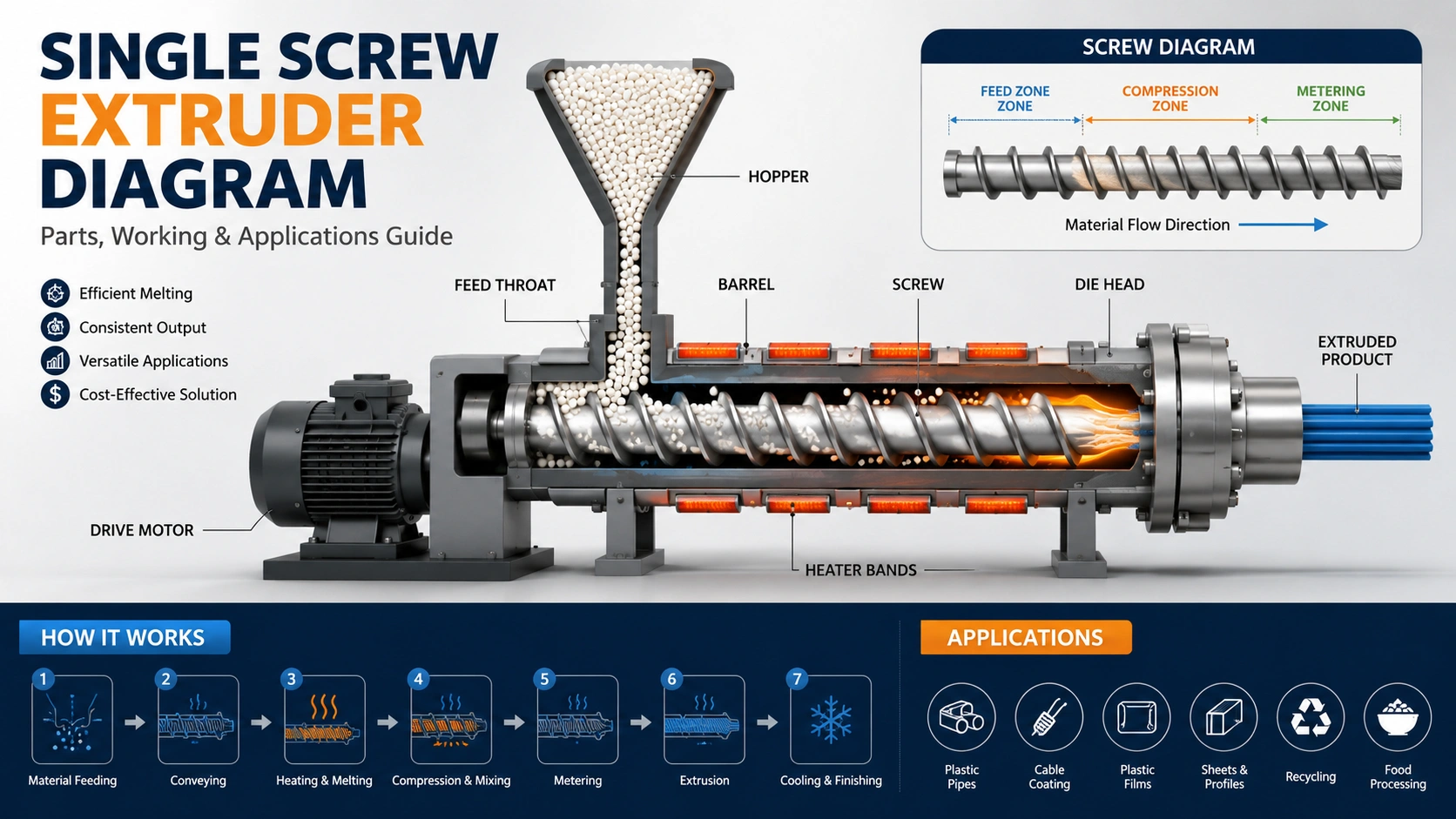
A typical single screw extruder diagram illustrates the machine's major components and material flow path. While designs may vary depending on the application, most extruders contain the following essential parts:
1. Hopper
The hopper serves as the feeding section where raw materials such as plastic pellets, granules, or powders are loaded into the machine.
2. Feed Throat
The feed throat connects the hopper to the barrel and ensures a smooth transfer of raw material into the processing section.
3. Barrel
The barrel is a cylindrical housing that contains the rotating screw. It is equipped with heating zones that gradually increase the material temperature.
4. Screw
The screw is the most important component of the extruder. It transports, compresses, melts, and mixes the material as it moves through the barrel.
5. Heater Bands
External heaters mounted around the barrel provide the thermal energy required for material melting and processing.
6. Die Head
The die head shapes the molten material into the desired profile, tube, sheet, film, cable coating, or other product forms.
7. Drive Motor
The motor supplies the rotational force needed to turn the screw and maintain production output.
8. Control System
Modern extrusion systems include temperature controllers, speed regulators, pressure monitoring devices, and automation features for precise process control.
Main Sections of the Screw Diagram
The screw diagram generally divides the screw into three distinct zones:
Feed Zone
This section receives raw material from the hopper and conveys it forward. Material remains mostly solid in this area.
Compression Zone
The channel depth gradually decreases, increasing pressure and initiating material melting.
Metering Zone
The fully molten material is homogenized and delivered uniformly toward the die for consistent product quality.
Each zone plays a critical role in ensuring efficient material processing and stable extrusion performance.
How Does a Single Screw Extruder Work?
The working principle of a single screw extruder is relatively straightforward but highly effective.
Step 1: Material Feeding
Raw material enters the hopper and moves into the feed section of the barrel.
Step 2: Conveying Process
The rotating screw transports the material forward through the barrel.
Step 3: Heating and Melting
Heat generated by barrel heaters and mechanical friction gradually melts the material.
Step 4: Compression and Mixing
The screw compresses and mixes the molten material to achieve a uniform melt consistency.
Step 5: Metering
The metering section ensures a steady flow rate and consistent pressure before the material reaches the die.
Step 6: Product Formation
The molten material exits through the die and forms the desired product shape.
Step 7: Cooling and Finishing
The extruded product is cooled, sized, cut, or wound depending on the manufacturing application.
Importance of Extruder Screw Design
The performance of any extruder largely depends on screw geometry and design. A properly designed screw improves melting efficiency, output rate, energy consumption, and product quality.
Several design factors influence screw performance:
- Screw diameter
- Screw length-to-diameter ratio (L/D Ratio)
- Compression ratio
- Flight depth
- Helix angle
- Pitch design
- Mixing elements
These factors directly affect material flow, pressure generation, melting behavior, and production stability.
Extruder Screw Design Calculation
The process of extruder screw design calculation involves determining the dimensions and operating parameters required to achieve desired production rates and material characteristics.
Engineers typically evaluate:
Screw Diameter
Larger diameters generally provide higher throughput capacity.
Length-to-Diameter Ratio (L/D)
A higher L/D ratio improves melting and mixing efficiency.
Compression Ratio
This ratio determines how effectively the material is compressed and melted.
Output Capacity
The screw design must match the required production volume.
Material Characteristics
Different polymers require different screw geometries due to variations in viscosity and melting behavior.
Accurate extruder screw design calculation helps maximize productivity while minimizing defects and energy consumption.
Advantages of Single Screw Extruders
The popularity of single screw extruders continues because of their numerous benefits.
Simple Construction
The machine design is straightforward, making operation and maintenance easier.
Cost-Effective Solution
Compared to more complex systems, single screw extruders offer lower initial investment and operating costs.
Reliable Performance
These machines provide consistent output for a wide range of materials.
Easy Maintenance
Fewer moving components reduce maintenance requirements and downtime.
Versatile Applications
Single screw extruders can process various thermoplastics, rubber compounds, food products, and specialty materials.
Industrial Applications of Single Screw Extruders
Single screw extrusion technology serves a wide variety of industries.
Plastic Pipe Manufacturing
Used for producing PVC, HDPE, and PPR pipes.
Cable Industry
Essential for wire insulation and cable sheathing applications.
Plastic Film Production
Used in packaging, agricultural films, and industrial films.
Sheet Extrusion
Produces plastic sheets for thermoforming and construction applications.
Profile Manufacturing
Creates window profiles, trims, channels, and structural components.
Food Processing
Certain food products are manufactured using specialized extrusion equipment.
Recycling Industry
Extruders help process recycled plastic materials into reusable products.
Challenges in Extrusion Operations
Although highly efficient, extrusion processes may face certain operational challenges.
- Uneven melting
- Material degradation
- Pressure fluctuations
- Die build-up
- Excessive energy consumption
- Poor product dimensional stability
Proper machine maintenance, optimized screw design, and accurate process control help minimize these issues.
Future Trends in Extrusion Technology
Current extrusion systems are trending toward automation and energy efficiency. Technologies like the Internet of Things monitoring system, predictive maintenance, smart process control, and improved screw designs are revolutionizing manufacturing processes.
Another trend that is impacting the demand for extrusion systems is sustainable manufacturing, which calls for systems that can handle recyclable and bio-based materials.
Conclusion
Knowing the single screw extruder diagram, parts, and how the machines work is very important to everyone in the manufacturing industry. All these features, including screw diagram, barrel design, and even extruder screw design calculation, play a key role in making the machine function properly.
The extruder machine is one such important piece of equipment that is still used today in many industries, from plastics, cables, packaging, construction, recycling, and so on, for manufacturing quality products using advanced techniques. Through the Eindia Connect B2B Portal or Market Place, businesses can find reliable extruder machinery manufacturers and suppliers.