Thermal Power Plant: How Does it Work, Principle & Diagram
E India Connect, a trusted B2B Portal and Marketplace, helps businesses connect with verified manufacturers, suppliers, and service providers across various industrial sectors. Among the many industries that power modern economies, the energy sector plays a crucial role. One of the most widely used methods of electricity generation is through a thermal power plant. These plants convert heat energy into electrical energy and contribute significantly to the world's power generation capacity.
Understanding how a thermal power station works can help industries, students, and professionals gain valuable insights into the electricity generation process.
What Is a Thermal Power Plant?
A power plant is a facility designed to generate electricity by converting various forms of energy into electrical power. In a thermal power station, heat energy produced from burning fuels such as coal, natural gas, or oil is used to generate steam, which drives turbines connected to generators.
The electricity produced through this process is known as thermal electricity. Thermal power generation remains one of the most common methods of electricity production worldwide due to its reliability and large-scale power generation capability.
Working Principle of a Thermal Power Plant
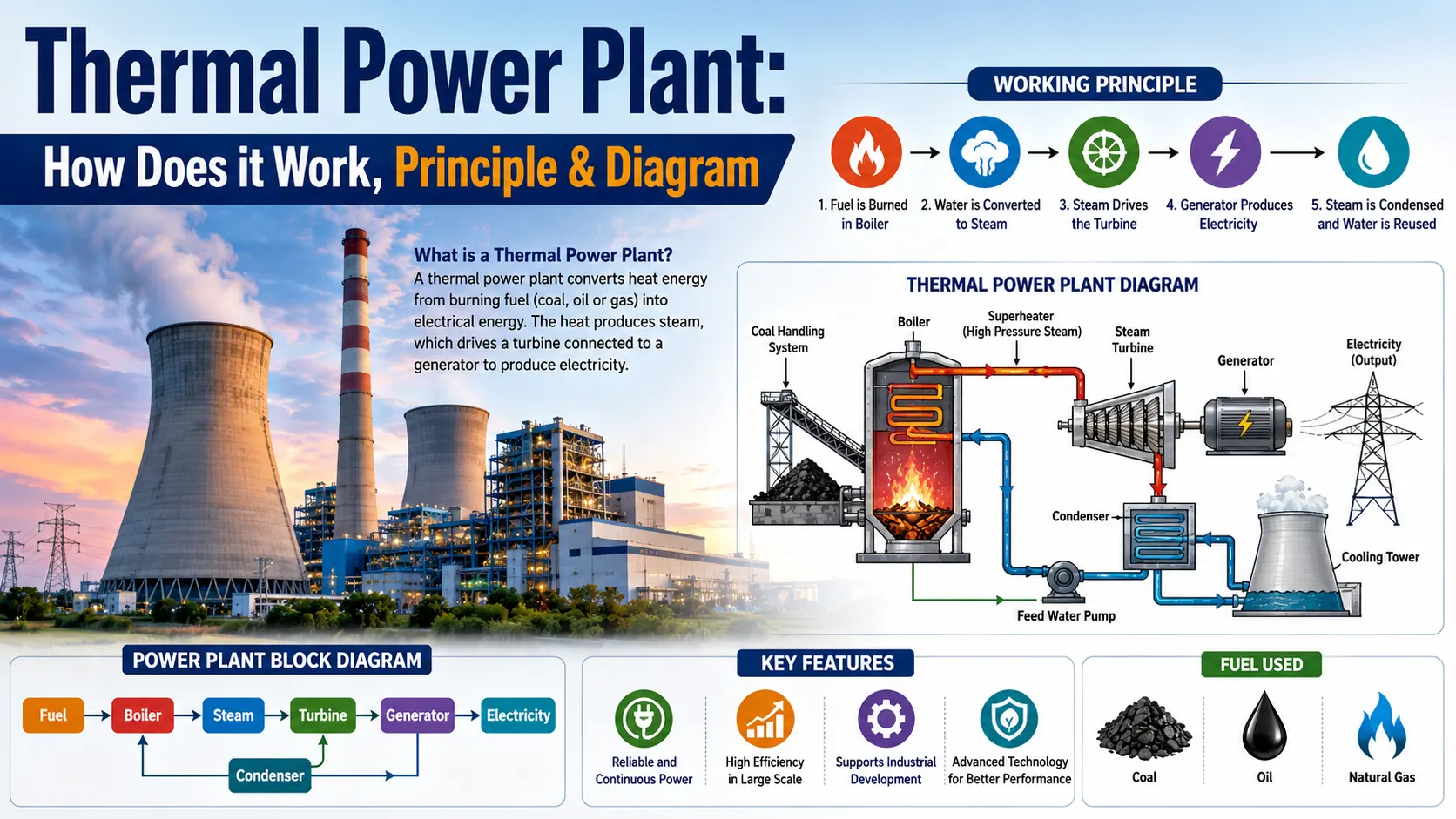
The basic working principle of a thermal plant is based on the conversion of heat energy into mechanical energy and then into electrical energy.
The process involves the following stages:
- Fuel combustion generates heat.
- Heat converts water into high-pressure steam.
- Steam rotates the turbine blades.
- The turbine drives a generator.
- The generator produces electricity.
- Steam is condensed back into water and reused.
This continuous cycle allows the power plant to generate electricity efficiently and consistently.
Thermal Power Plant Diagram
A thermal power plant diagram helps visualize the complete electricity generation process. The major components generally included in the system are:
- Coal handling system
- Boiler
- Superheater
- Steam turbine
- Generator
- Condenser
- Cooling tower
- Feed water pump
- Chimney
These components work together to ensure efficient production of thermal electricity.
Power Plant Block Diagram
The simplified power plant block diagram can be represented as:
Fuel → Boiler → Steam → Turbine → Generator → Electricity
At the same time:
Steam → Condenser → Water → Boiler
This closed-loop system ensures continuous operation while maximizing energy utilization.
Major Components of a Thermal Power Plant
1. Boiler
The boiler is the heart of the thermal plant. It burns fuel to produce heat, which converts water into steam.
Functions:
- Generates high-pressure steam
- Transfers heat efficiently
- Supports continuous power generation
2. Steam Turbine
The steam turbine converts thermal energy into mechanical energy.
Functions:
- Receives high-pressure steam
- Rotates turbine blades
- Drives the generator shaft
The efficiency of the turbine directly affects overall power plant performance.
3. Generator
The generator converts mechanical energy into electrical energy.
Functions:
- Produces electricity
- Supplies power to transmission systems
- Maintains stable electrical output
This is where thermal electricity is finally generated.
4. Condenser
The condenser cools and converts exhaust steam back into water.
Functions:
- Recovers water for reuse
- Improves cycle efficiency
- Reduces water consumption
5. Cooling Tower
Cooling towers remove excess heat from the system.
Functions:
- Maintains condenser efficiency
- Supports continuous plant operation
- Improves overall performance
Advantages of Thermal Power Plants
Thermal power stations continue to be widely used because of several advantages.
- Reliable Power Generation: A thermal power plant can operate continuously and provide a stable electricity supply regardless of weather conditions.
- High Power Output: These plants can generate large amounts of electricity to meet industrial and residential demand.
- Established Technology: The technology used in thermal plants is mature, well-understood, and widely implemented around the world.
- Suitable for Large Industries: Large manufacturing facilities often depend on thermal electricity generated by conventional power stations.
Applications of Thermal Electricity
The electricity generated by thermal power stations is used across multiple sectors:
- Manufacturing industries
- Commercial buildings
- Residential areas
- Transportation infrastructure
- Hospitals
- Educational institutions
- Data centers
Without reliable thermal electricity, many industrial and commercial activities would be difficult to sustain.
Challenges Faced by Thermal Power Plants
Although thermal power generation offers many benefits, it also faces certain challenges.
- Fuel Consumption: Large quantities of coal, oil, or gas are required to operate the plant.
- Environmental Impact: Fuel combustion produces emissions that can affect the environment.
- Water Requirements: Cooling and steam generation processes require substantial amounts of water.
- Maintenance Costs: Large-scale equipment requires regular maintenance to ensure efficient operation.
How E India Connect Supports the Power Industry
As a leading B2B Portal and Marketplace, E India Connect helps businesses connect with trusted suppliers, manufacturers, contractors, and industrial service providers. We offer and provide a platform where buyers can discover power generation equipment, industrial machinery, engineering solutions, and energy-related products from verified vendors.
Whether businesses require components for a power plant, industrial automation systems, turbines, boilers, or electrical equipment, E India Connect helps simplify sourcing and supplier discovery.
Conclusion
A thermal power plant plays a vital role in generating electricity by converting heat energy into electrical energy. Through the coordinated operation of boilers, turbines, generators, condensers, and cooling systems, these facilities produce reliable thermal electricity for industries and households.
Understanding the thermal power plant diagram and power plant block diagram helps explain the complete electricity generation process. As technology continues to evolve, modern thermal plant facilities are becoming more efficient, environmentally responsible, and capable of meeting the growing energy demands of the future.