What are KLD and MLD in Water and Wastewater Treatment?
In the water and wastewater treatment industry, plant capacities are commonly expressed using terms such as KLD (Kilolitres per Day) and MLD (Million Litres per Day). These units help engineers, consultants, industries, municipalities, and project developers determine the treatment and storage capacity required for various applications.
Understanding KLD and MLD is essential when planning a water treatment plant (WTP), sewage treatment plant (STP), effluent treatment plant (ETP), or wastewater recycling system. In this article, we explain the meaning of KLD and MLD, their importance, and their applications in water and wastewater treatment projects.
What is KLD?
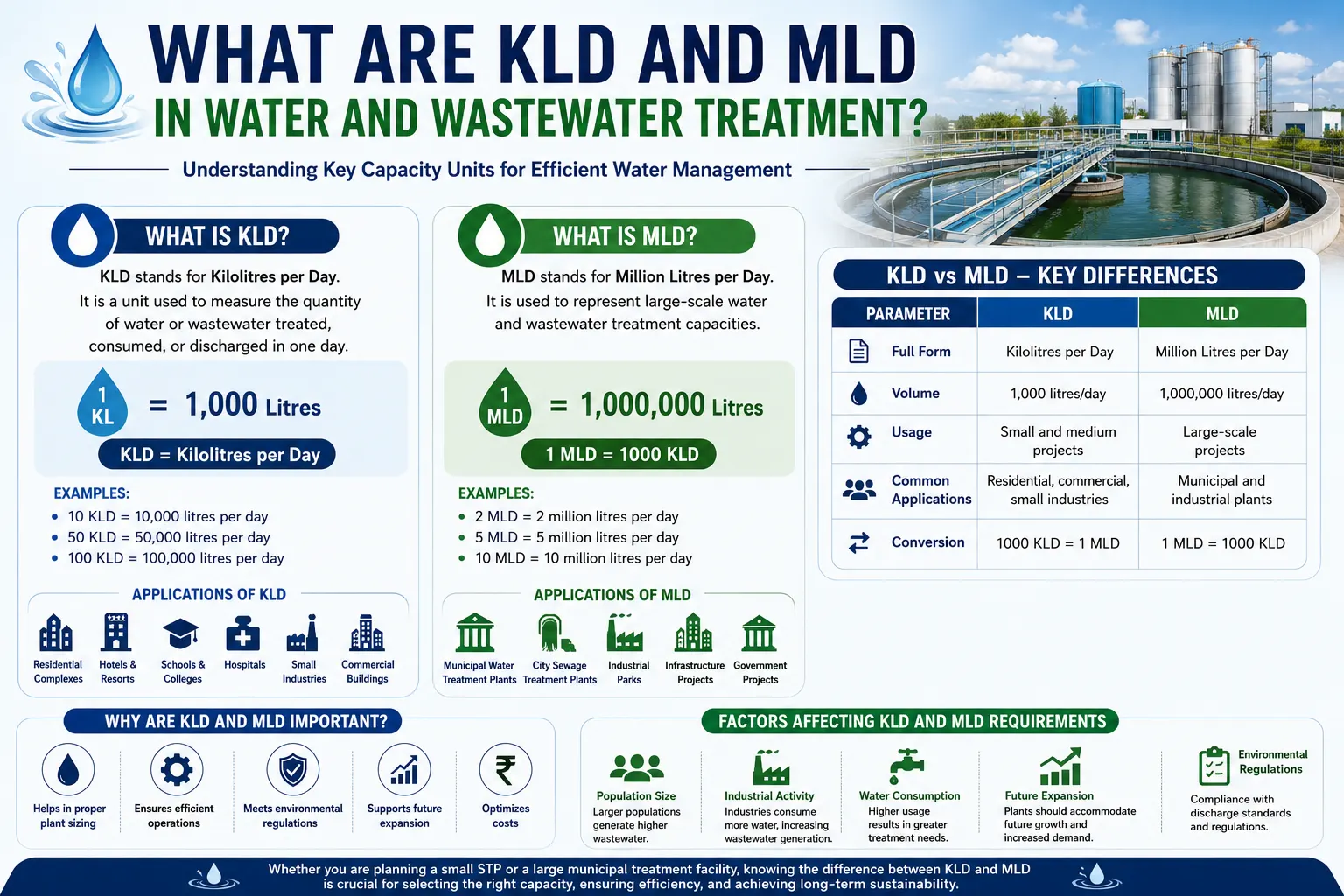
KLD stands for Kilolitres per Day. It is a unit used to measure the quantity of water or wastewater treated, consumed, or discharged in one day.
KLD Meaning
- 1 Kilolitre (KL) = 1,000 Litres
- KLD = Kilolitres per Day
For example:
- 10 KLD = 10,000 litres per day
- 50 KLD = 50,000 litres per day
- 100 KLD = 100,000 litres per day
KLD is generally used for small and medium-capacity treatment plants.
Applications of KLD
- Residential complexes
- Hotels and resorts
- Schools and colleges
- Hospitals
- Small industries
- Commercial buildings
- Housing societies
What is MLD?
MLD stands for Million Litres per Day. It is used to represent large-scale water and wastewater treatment capacities.
MLD Meaning
- 1 MLD = 1,000,000 litres per day
- 1 MLD = 1000 KLD
For example:
- 2 MLD = 2 million litres per day
- 5 MLD = 5 million litres per day
- 10 MLD = 10 million litres per day
MLD is commonly used for municipal and large industrial projects where water treatment requirements are significantly higher.
Applications of MLD
- Municipal water treatment plants
- City sewage treatment plants
- Industrial parks
- Smart city projects
- Large manufacturing facilities
- Government water supply projects
- Infrastructure developments
Difference Between KLD and MLD
|
Parameter |
KLD |
MLD |
|
Full Form |
Kilolitres per Day |
Million Litres per Day |
|
Volume |
1,000 litres/day |
1,000,000 litres/day |
|
Usage |
Small and medium projects |
Large-scale projects |
|
Common Applications |
Residential, commercial, small industries |
Municipal and industrial plants |
|
Conversion |
1000 KLD = 1 MLD |
1 MLD = 1000 KLD |
Why are KLD and MLD Important?
KLD and MLD measurements help engineers and plant designers determine:
- Water consumption requirements
- Wastewater generation volume
- Treatment plant sizing
- Pump and equipment selection
- Storage tank capacity
- Operational efficiency
- Future expansion planning
Accurate capacity calculations ensure that treatment systems perform efficiently and comply with environmental regulations.
KLD and MLD in Wastewater Treatment Plants
Wastewater treatment plants are designed according to the amount of wastewater generated daily. For example:
- A residential society may require a 50 KLD STP.
- A hospital may require a 100 KLD sewage treatment plant.
- A manufacturing unit may install a 500 KLD ETP.
- A municipality may operate a 20 MLD sewage treatment facility.
The plant capacity directly affects equipment selection, treatment processes, and operational costs.
Factors Affecting KLD and MLD Requirements
Several factors influence the required treatment capacity:
Population Size
Larger populations generate higher quantities of wastewater and require larger treatment plants.
Industrial Activity
Manufacturing processes often consume significant amounts of water, increasing wastewater generation.
Water Consumption
Higher water usage results in greater treatment requirements.
Future Expansion
Treatment plants should be designed to accommodate future growth and increased demand.
Environmental Regulations
Local regulations may dictate minimum treatment capacities and discharge standards.
Role of Digital B2B Platforms in Water Treatment Industry
Finding reliable manufacturers, suppliers, consultants, and service providers is important when planning water and wastewater treatment projects. E India Connect serves as a leading B2B portal and online marketplace that connects buyers with verified businesses across various industrial sectors, including water treatment, wastewater management, environmental engineering, industrial equipment, and infrastructure solutions.
Through E India Connect, businesses can explore a wide range of products and services, compare suppliers, and connect with industry professionals for project requirements. The platform helps manufacturers, suppliers, and buyers build valuable business connections and discover opportunities within the growing water treatment industry.
Benefits of Using E India Connect
- Connect with verified suppliers and manufacturers
- Explore water and wastewater treatment solutions
- Find industrial equipment and service providers
- Generate business leads
- Expand market reach
- Promote products and services online
- Access industry-specific business listings
Conclusion
KLD and MLD are essential units used to measure water consumption and wastewater treatment capacities. While KLD is suitable for smaller residential, commercial, and industrial applications, MLD is used for large-scale municipal and infrastructure projects. Understanding these units helps ensure proper plant design, efficient operations, and compliance with environmental standards.
Whether you are planning a small STP or a large municipal treatment facility, knowing the difference between KLD and MLD is crucial for selecting the right capacity. Businesses looking for reliable water treatment suppliers and industry connections can benefit from platforms like E India Connect, a trusted B2B marketplace that helps connect buyers and sellers across the water and wastewater treatment sector.