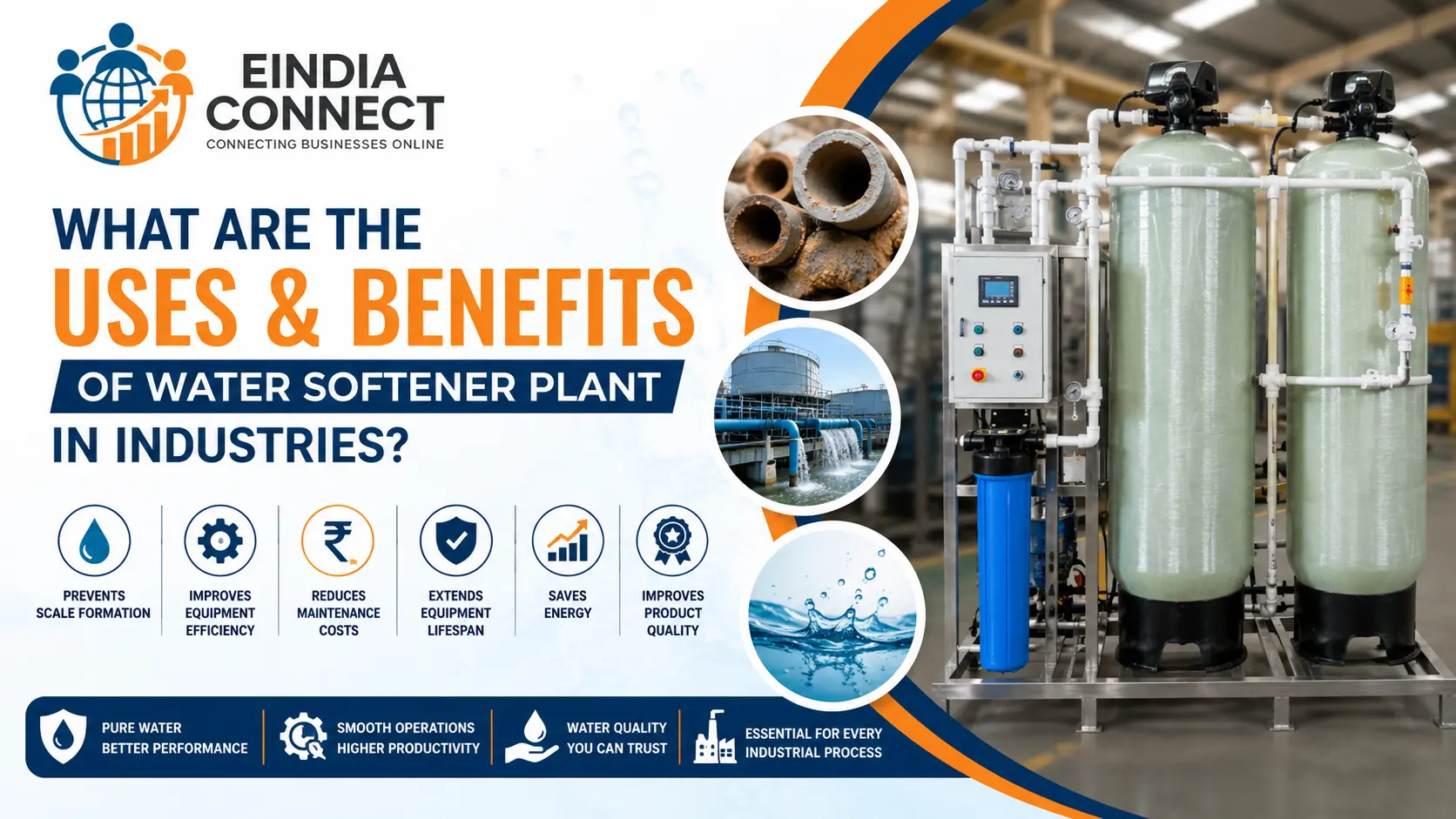
What are the Uses and Benefits of Water Softener Plant in Industries?
Water is among the essential resources utilized in numerous industrial sectors like manufacturing, food processing, pharmaceuticals, textiles, hospitality, electricity generation, and chemical industries. However, raw water contains minerals that cause water hardness such as calcium and magnesium. Such minerals may pose issues of scaling and affect the efficiency of equipment while increasing maintenance costs. As a result, most companies have been employing a softener plant in order to solve the above challenges.
A softner plant plays a crucial role in removing hardness from water, making it suitable for industrial applications. As a leading B2B business portal and marketplace, E India Connect helps businesses connect with trusted manufacturers, suppliers, dealers, and service providers of industrial water treatment solutions, including advanced water softening systems.
In this blog, we will discuss the uses, benefits, working principle, and industrial importance of water softening plants.
What is a Water Softener Plant?
A softener plant is a water treatment system designed to remove calcium and magnesium ions from hard water. These minerals are responsible for water hardness and can lead to scale formation in pipes, boilers, cooling towers, heat exchangers, and other industrial equipment.
The plant uses an ion exchange process where hardness-causing ions are replaced with sodium ions, producing soft water that is safe for industrial use.
Industries prefer a softening plant because it helps improve operational efficiency, reduce maintenance expenses, and extend equipment life.
Why is Water Softening Important in Industries?
Hard water can create several operational challenges for industrial facilities. Scale deposits accumulate inside pipelines and machinery, reducing heat transfer efficiency and increasing energy consumption.
Common problems caused by hard water include:
- Scale formation in boilers
- Reduced heat exchanger efficiency
- Increased energy costs
- Frequent equipment maintenance
- Blocked pipelines
- Lower productivity
- Reduced equipment lifespan
A properly designed softner plant eliminates these issues and ensures reliable industrial operations.
Softener Plant Working
Understanding softener plant working is important for industries planning to invest in water treatment systems.
The process primarily involves ion exchange technology, which removes hardness-causing minerals from water.
Step 1: Raw Water Entry
Hard water enters the softening unit through the inlet pipeline.
Step 2: Ion Exchange Process
The water passes through a resin bed containing sodium ions. As the water flows through the resin, calcium and magnesium ions are exchanged with sodium ions.
Step 3: Soft Water Production
The treated water exits the system as soft water, ready for industrial use.
Step 4: Regeneration Cycle
After a certain period, the resin becomes saturated with hardness minerals. A salt solution is then used to regenerate the resin and restore its effectiveness.
This efficient softener plant working process ensures a continuous supply of soft water for industrial applications.
Softening Plant Process
The softening plant process consists of several stages that help deliver high-quality treated water.
- Raw Water Collection- Water is collected from the source and directed into the treatment system.
- Filtration- Basic filtration removes suspended particles, dirt, and debris.
- Ion Exchange Softening- The water passes through ion exchange resin where hardness minerals are removed.
- Soft Water Storage- The treated water is stored in tanks for industrial usage.
- Regeneration- The resin is periodically regenerated using a brine solution to maintain efficiency.
The softening plant process is highly reliable and capable of handling large water volumes required by industries.
Uses of Water Softener Plant in Industries
A softener plant is widely used across various industrial sectors due to its ability to improve water quality.
- Manufacturing Industries- Manufacturing facilities use soft water to protect machinery, boilers, and processing equipment.
- Textile Industry- Soft water improves dyeing quality and reduces fabric processing issues.
- Food and Beverage Industry- Softened water is used in food processing, cleaning operations, and beverage production.
- Pharmaceutical Industry- Pharmaceutical companies require high-quality water for production processes and equipment cleaning.
- Hospitality Sector- Hotels, resorts, and hospitals use water softeners to improve water quality and reduce maintenance costs.
- Power Plants- Power generation facilities use soft water in boilers and cooling systems to prevent scaling.
- Chemical Industries- Chemical processing units rely on treated water for efficient production operations.
Benefits of Water Softener Plant
- Prevents Scale Formation- One of the biggest advantages of a softner plant is its ability to prevent scale buildup in pipes, boilers, and industrial equipment.
- Improves Equipment Efficiency- Soft water allows machinery to operate more efficiently by reducing mineral deposits.
- Reduces Maintenance Costs- Less scaling means fewer breakdowns and lower repair expenses.
- Extends Equipment Lifespan- Industrial equipment lasts longer when protected from hard water damage.
- Saves Energy- Scale deposits reduce heat transfer efficiency, leading to higher energy consumption. Soft water helps maintain optimal performance.
- Improves Product Quality- Many industries require consistent water quality to maintain product standards.
- Increases Productivity- Reliable equipment performance leads to fewer interruptions and improved productivity.
Components of a Water Softener Plant
A modern softening plant consists of several essential components.
- Pressure Vessel- Houses the ion exchange resin.
- Ion Exchange Resin- Removes hardness-causing minerals from water.
- Brine Tank- Stores salt solution used for regeneration.
- Control Valve- Regulates water flow and regeneration cycles.
- Distribution System- Ensures uniform water flow through the resin bed.
- Storage Tank- Stores treated soft water for industrial applications.
These components work together to provide effective water softening.
How to Choose the Right Softener Plant?
Selecting the right softener plant depends on several factors.
- Water Hardness Level- Analyze the hardness level of incoming water before selecting a system.
- Water Consumption- Choose a plant that can meet daily industrial water requirements.
- Regeneration Efficiency- Efficient regeneration reduces operating costs.
- Automation Features- Modern systems offer automated controls for better performance.
- Maintenance Requirements- Choose equipment that is easy to maintain and operate.
- Supplier Reliability- Working with trusted manufacturers and suppliers ensures long-term support and quality products.
Finding Reliable Water Softener Plant Suppliers
Businesses looking for water treatment solutions should work with experienced manufacturers and suppliers.
Through E India Connect, buyers can connect with verified:
- Water softener plant manufacturers
- Industrial water treatment suppliers
- Water treatment equipment exporters
- Service providers
- Water treatment consultants
The platform simplifies supplier discovery and helps businesses compare solutions based on quality, pricing, and specifications.
Future of Industrial Water Softening Systems
Modern industries are increasingly adopting advanced water treatment technologies to improve efficiency and sustainability.
Latest trends include:
- Fully automated softening systems
- Smart monitoring solutions
- Energy-efficient designs
- High-capacity treatment plants
- Eco-friendly regeneration systems
- Integrated water management solutions
These advancements are making industrial water treatment more reliable and cost-effective.
Conclusion
A softener plant is an essential investment for industries that depend on high-quality water for production, processing, and equipment operation. By removing hardness-causing minerals, a softner plant helps prevent scaling, improve equipment efficiency, reduce maintenance costs, and enhance overall productivity.
Understanding softener plant working and the softening plant process allows businesses to choose the right water treatment solution for their operational requirements. Whether it is manufacturing, pharmaceuticals, textiles, food processing, hospitality, or power generation, water softening systems play a critical role in ensuring smooth and efficient industrial operations.
As a trusted B2B business portal and marketplace, E India Connect helps businesses connect with reliable manufacturers and suppliers of water treatment equipment, making it easier to find the right softening plant solutions for industrial needs.