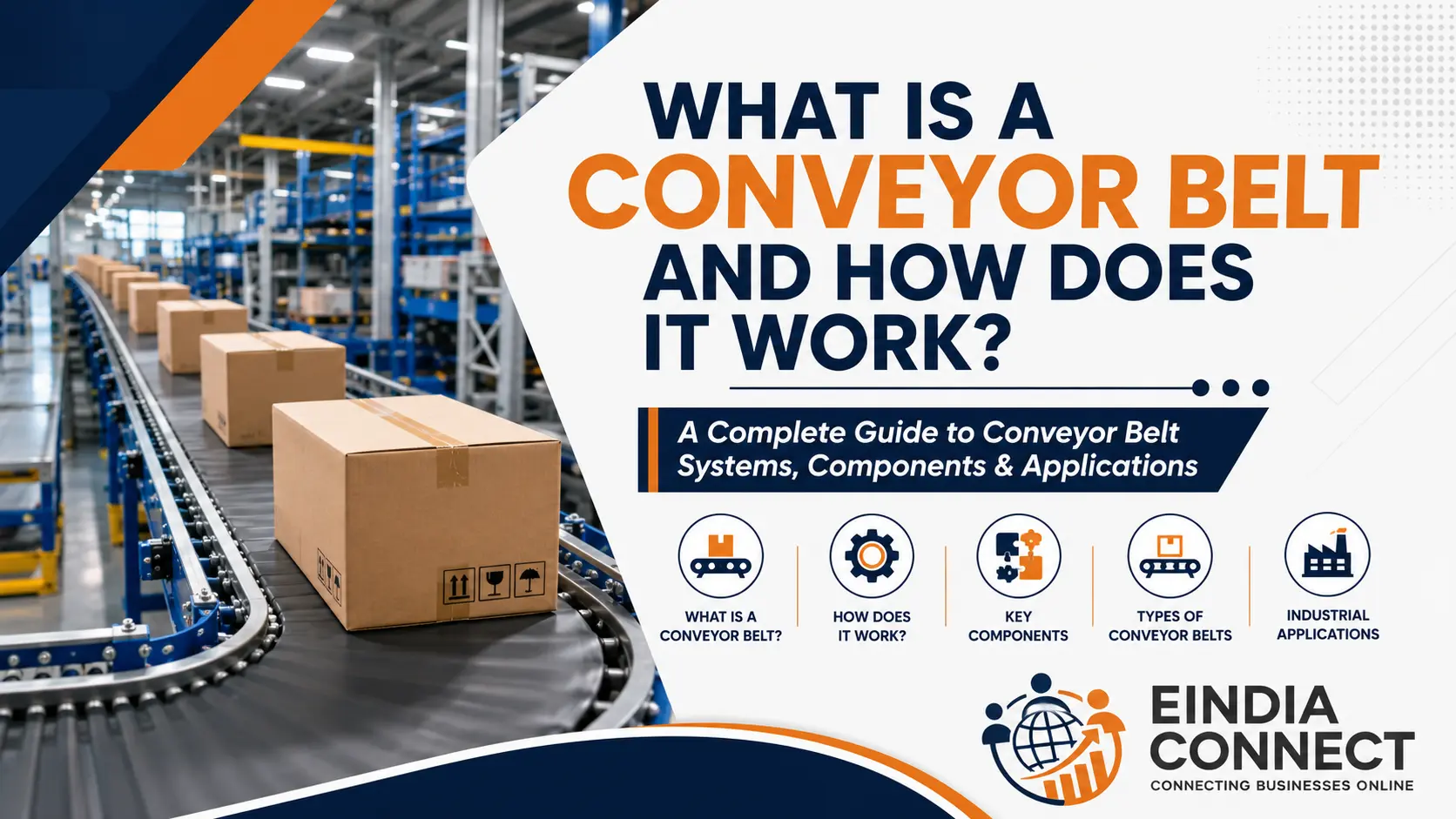
What is a Conveyor Belt and How Does It Work?
In today's industrial world, material handling plays a critical role in improving productivity and operational efficiency. Whether it is a manufacturing plant, warehouse, airport, mining site, food processing unit, or logistics center, businesses rely heavily on automated systems to move products from one location to another. One of the most widely used material handling solutions is the conveyor belt.
But what is a conveyor belt, and why is it so important in modern industries? Understanding how conveyor systems work can help businesses choose the right material handling solution for their operations.
As a leading B2B business directory and marketplace, E India Connect helps buyers connect with trusted conveyor system manufacturers, suppliers, and industrial equipment providers across India. In this blog, we will explore the meaning, working principle, components, types, benefits, and applications of conveyor belt systems.
What is a Conveyor Belt?
To understand what is a conveyor belt, it is important to know its basic function. A conveyor belt is a continuous moving belt used to transport materials, products, or goods from one point to another with minimal human effort.
In simple terms, a conveyor belt is a mechanical material handling system designed to improve efficiency and reduce manual labor. These systems are commonly used for moving raw materials, finished products, packages, food items, and industrial goods.
When people ask what is conveyor, the answer generally refers to a machine or system that transports materials automatically within a facility. Conveyor belts are among the most popular and widely used conveyor systems worldwide.
Define Conveyor Belt
If we define conveyor belt, it can be described as:
"A continuous loop of material that rotates around pulleys and is used to transport goods, materials, or products efficiently from one location to another."
The belt is usually powered by an electric motor and supported by rollers or a flat surface. Depending on the application, conveyor belts can be manufactured using rubber, PVC, fabric, stainless steel, polyurethane, or other specialized materials.
History of Conveyor Belts
The concept of conveyer belts has existed for more than a century. Early conveyor systems were simple mechanical devices used in mining and agriculture. Over time, advancements in technology led to the development of automated conveyor systems capable of handling complex industrial operations.
Today, conveyor belts are an essential part of manufacturing, warehousing, logistics, food processing, pharmaceuticals, automotive production, and many other industries.
How Does a Conveyor Belt Work?
A conveyor system consists of a continuous belt stretched between two or more pulleys. One pulley is powered by a motor, known as the drive pulley, while the other pulley helps guide the belt.
The basic working process includes:
- Motor Activation- An electric motor powers the drive pulley.
- Belt Movement- As the drive pulley rotates, the conveyor belt moves continuously.
- Material Placement- Products or materials are placed on the moving belt.
- Material Transportation- The moving belt carries materials from one location to another.
- Material Discharge- The product is unloaded at the designated destination.
This simple yet efficient process enables industries to transport large volumes of materials quickly and safely.
Main Components of a Conveyor Belt System
A conveyor system consists of several important components.
- Conveyor Belt- The belt itself is the primary component responsible for carrying materials.
- Drive Pulley- The drive pulley transfers power from the motor to move the belt.
- Idler Rollers- These rollers support the conveyor belt and reduce friction.
- Motor- The motor provides the power needed to operate the system.
- Frame Structure- The frame supports the entire conveyor assembly.
- Control System- Modern conveyor systems often include automated controls and sensors for improved efficiency.
Types of Conveyor Belts
Different industries require different types of conveyor solutions. Some commonly used conveyor belts include:
- Flat Belt Conveyor- Widely used in warehouses and manufacturing facilities for moving packaged goods.
- Roller Conveyor- Uses rollers to transport products and is suitable for heavy loads.
- Inclined Conveyor- Designed to move materials between different heights.
- Modular Belt Conveyor- Uses interlocking plastic segments and is popular in food processing industries.
- Cleated Conveyor- Features raised sections that prevent materials from slipping during transportation.
- Industrial Conveyor Systems- Heavy-duty conveyor systems designed for mining, cement plants, and large manufacturing operations.
Benefits of Conveyor Belts
The increasing demand for conveyer belts is driven by the numerous advantages they offer businesses.
- Improved Productivity- Conveyor systems move materials continuously, reducing delays and increasing production output.
- Reduced Labor Costs- Automation minimizes manual handling requirements and lowers labor expenses.
- Faster Material Handling- Products can be transported quickly across long distances within a facility.
- Enhanced Workplace Safety- Conveyor systems reduce the need for manual lifting and carrying, lowering the risk of workplace injuries.
- Consistent Performance- Conveyor belts provide reliable and uniform material movement.
- Better Space Utilization- Modern conveyor designs help optimize facility layouts and improve workflow efficiency.
Industries That Use Conveyor Belts
Conveyor systems are widely used across numerous industries.
- Manufacturing Industry- Used for assembly lines and production processes.
- Warehousing and Logistics- Facilitates order fulfillment and package movement.
- Food Processing Industry- Transports food products safely and efficiently.
- Pharmaceutical Industry- Used for packaging and material handling applications.
- Mining Industry- Moves bulk materials such as coal, minerals, and ores.
- Airports- Used for baggage handling systems.
- E-commerce Sector- Supports high-volume package sorting and distribution operations.
How to Choose the Right Conveyor Belt
Selecting the right conveyor belt depends on several factors.
- Material Type- The nature of the material being transported determines belt specifications.
- Load Capacity- The conveyor must handle the required weight efficiently.
- Operating Environment- Temperature, humidity, and working conditions influence belt selection.
- Belt Material- Different materials offer varying levels of durability and performance.
- Maintenance Requirements- Choosing a low-maintenance system can reduce operating costs.
Future of Conveyor Belt Technology
Automation and smart manufacturing are driving innovation in conveyor systems. Modern conveyor belts are increasingly equipped with sensors, automation controls, and monitoring systems that improve efficiency and reduce downtime.
Industries are also adopting energy-efficient conveyor solutions to support sustainability goals while improving operational performance.
How E India Connect Helps Businesses
Finding reliable conveyor manufacturers and suppliers can be challenging. E India Connect simplifies this process by connecting buyers with verified industrial equipment manufacturers, suppliers, exporters, and service providers across India.
As a trusted B2B marketplace, E India Connect enables businesses to compare products, evaluate suppliers, and make informed purchasing decisions. Whether you are looking for conveyor systems, material handling equipment, automation solutions, or industrial machinery, our platform helps you connect with the right business partners.
Conclusion
Understanding what is a conveyor belt and how it works is essential for businesses looking to improve material handling efficiency. A conveyor belt is a vital component of modern industrial operations, helping organizations transport materials quickly, safely, and cost-effectively.
From manufacturing plants and warehouses to logistics centers and food processing units, conveyor systems continue to play a key role in industrial automation. By investing in the right conveyor solution and connecting with trusted suppliers through E India Connect, businesses can improve productivity, reduce operational costs, and support long-term growth.