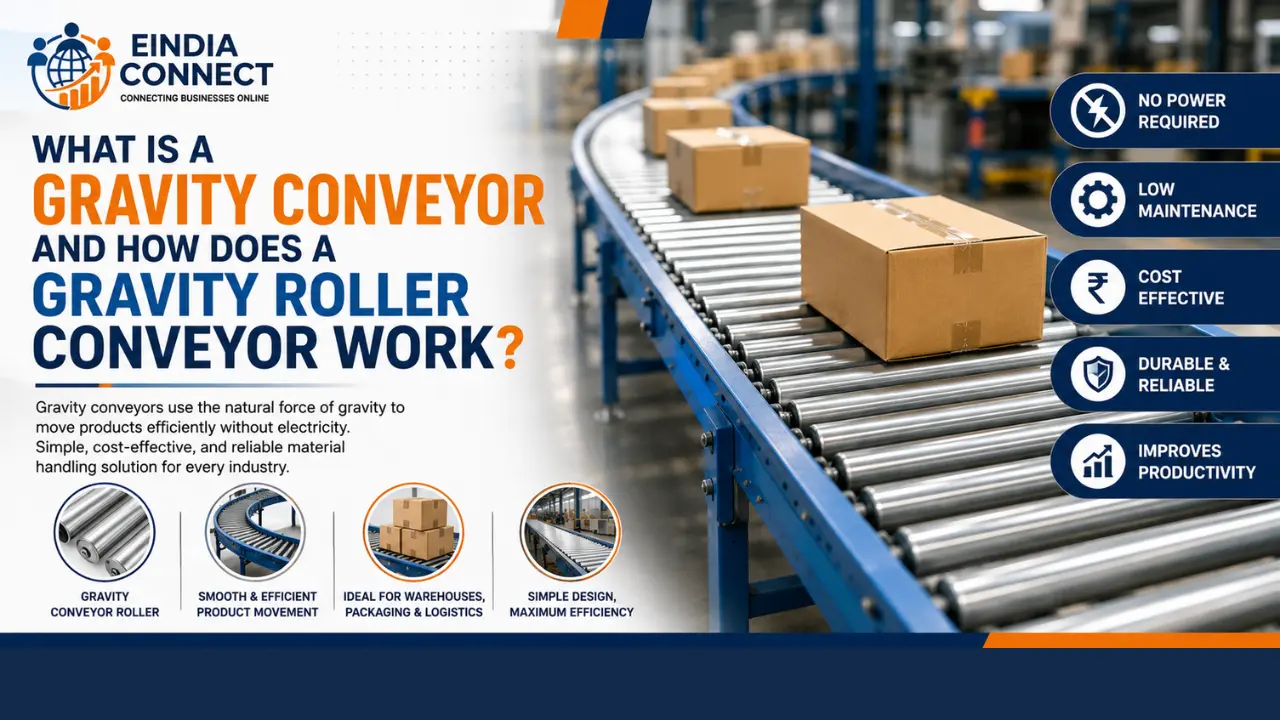
What is a Gravity Conveyor and How Does a Gravity Roller Conveyor Work?
The handling of material is essential to operations in manufacturing, warehousing, logistics, packaging, and distribution industries. Companies continually strive to come up with an efficient and economical way to transport products from one point to another while cutting down on labor and operational costs. The solution that is simple and highly effective, which is used throughout the world, is the gravity conveyor.
As opposed to the powered conveyor system, the gravity conveyor does not depend on any artificial energy source. Instead, the product can be moved either by the gravitational pull of the earth or by manual pushing. The simplicity of the construction and low maintenance are the characteristics that attract people to use gravity conveyors.
Let us learn about the gravity conveyor, its operation, components, benefits, uses, and more in this blog.
What is a Gravity Conveyor?
A gravity conveyor is a material handling system that moves products, cartons, packages, and other items without using motors or external power sources. Instead, the conveyor relies on gravity or manual force to move materials along the conveyor path.
These conveyors are commonly installed with a slight incline, allowing products to move naturally from one point to another. In some applications, workers manually push the products across the conveyor surface.
Because they do not require electricity or complex drive systems, gravity conveyors are considered one of the most economical conveyor solutions available.
What is a Gravity Roller Conveyor?
A gravity roller conveyor is a specific type of gravity conveyor that uses rollers mounted within a frame. Products placed on the rollers move smoothly due to gravity or manual pushing.
The rollers rotate freely, reducing friction and making it easier to transport items across short and medium distances.
Gravity roller conveyors are commonly used for:
- Cartons
- Boxes
- Plastic containers
- Pallets
- Crates
- Industrial components
- Packaging materials
These systems are particularly effective in warehouses, assembly lines, and distribution centers.
How Does a Gravity Roller Conveyor Work?
The working principle of a gravity roller conveyor is straightforward.
- Product Placement- Products are placed on the conveyor rollers.
- Gravity Movement- When the conveyor is installed at a slight angle, gravity naturally pulls the product forward.
- Roller Rotation- As the product moves, each gravity conveyor roller rotates freely, allowing smooth transportation with minimal resistance.
- Product Transfer- The item continues moving until it reaches the designated endpoint, work station, or collection area.
Since the system requires little or no power, it significantly reduces operating costs while improving material flow.
Main Components of Gravity Conveyors
Although gravity conveyors have a simple design, they consist of several important components.
Conveyor Frame
The frame provides structural support for the entire conveyor system.
Frames are commonly manufactured from:
- Mild steel
- Stainless steel
- Aluminum
Gravity Conveyor Roller
The gravity conveyor roller is the most important component of the system. These rollers support the load and enable smooth movement of products.
Rollers may be manufactured from:
- Steel
- Stainless steel
- PVC
- Aluminum
Bearings
Bearings allow the rollers to rotate freely and efficiently.
Support Legs
Adjustable support structures maintain the required conveyor height and incline.
Side Guides
Optional side guides help keep products aligned during movement.
Types of Gravity Conveyors
Different industries require different conveyor configurations. As a result, several types of gravity conveyors are available.
Gravity Roller Conveyor
The most common type, using rotating rollers for product movement.
Suitable for:
- Cartons
- Boxes
- Pallets
- Industrial products
Skate Wheel Conveyor
Uses small wheels instead of rollers.
Ideal for:
- Lightweight packages
- Shipping operations
- Distribution centers
Flexible Gravity Conveyor
A portable conveyor that can expand, contract, and change direction.
Benefits include:
- Easy storage
- Flexible layout options
- Quick installation
Spiral Gravity Conveyor
Designed for moving products between different floor levels while saving space.
Advantages of Gravity Conveyors
The popularity of gravity conveyor systems is largely due to their numerous benefits.
- No Power Consumption- One of the biggest advantages is that gravity conveyors operate without electricity.
- Low Maintenance- With fewer moving parts and no motors, maintenance requirements are minimal.
- Cost-Effective Solution- Gravity conveyors typically have lower installation and operating costs compared to powered systems.
- Easy Installation- Most systems can be installed quickly with minimal infrastructure modifications.
- Flexible Design- Gravity conveyors can be customized to suit various layouts and production requirements.
- Improved Productivity- They help streamline material handling operations and reduce manual carrying efforts.
Applications of Gravity Roller Conveyors
The versatility of gravity roller conveyors makes them suitable for numerous industries.
Warehousing and Distribution
Used for:
- Order fulfillment
- Product sorting
- Shipping operations
- Package handling
Manufacturing Facilities
Support assembly lines and material transfer processes.
Packaging Industry
Move cartons and packaged products efficiently.
E-Commerce Operations
Assist in handling large volumes of parcels and packages.
Food Processing Industry
Transport packaged food products within processing facilities.
Automotive Industry
Used for moving components between workstations.
Pharmaceutical Industry
Support packaging and logistics operations.
Industries Using Gravity Conveyors
Today, gravity conveyor systems are widely used in:
- Logistics companies
- Warehouses
- Manufacturing plants
- Packaging facilities
- Retail distribution centers
- Food processing units
- Automotive factories
- Pharmaceutical industries
Their simple operation and low operating costs make them suitable for businesses of all sizes.
Factors to Consider Before Buying a Gravity Conveyor
Selecting the right conveyor system requires careful evaluation of several factors.
- Product Weight- Choose rollers and frame materials capable of supporting the intended load.
- Product Dimensions- The size of transported items influences conveyor width and roller spacing.
- Conveyor Length- Determine the distance products need to travel.
- Available Space- Evaluate facility layout and installation requirements.
- Material Type- Select appropriate roller materials based on operating conditions.
- Future Expansion- Consider whether the system may need to be expanded as production grows.
Gravity Conveyor vs Powered Conveyor
Many businesses compare gravity conveyors with powered conveyor systems.
Gravity Conveyor
Advantages:
- Lower cost
- No electricity required
- Easy maintenance
- Simple operation
Powered Conveyor
Advantages:
- Handles heavy loads
- Suitable for long distances
- Automated operation
- Greater control over product movement
For short-distance transportation and cost-sensitive applications, gravity conveyors are often the preferred solution.
Future of Gravity Conveyor Systems
Although automation continues to grow, gravity conveyors remain highly relevant due to their simplicity and efficiency.
Current trends include:
- Modular conveyor designs
- Corrosion-resistant materials
- Hybrid conveyor systems
- Improved roller technologies
- Space-saving layouts
These advancements help businesses maximize efficiency while maintaining low operating costs.
Finding Gravity Conveyor Manufacturers Through E India Connect
As a leading B2B marketplace, E India Connect helps buyers connect with trusted manufacturers, suppliers, and service providers across India.
Businesses can explore suppliers offering:
- Gravity conveyor systems
- Gravity roller conveyors
- Industrial conveyor solutions
- Material handling equipment
- Warehouse automation systems
- Custom conveyor designs
The platform enables buyers to compare products, request quotations, and connect directly with industry-leading manufacturers.
Conclusion
A gravity conveyor is one of the most practical and economical material handling solutions available today. By using gravity instead of external power, businesses can reduce operating costs while improving workflow efficiency. The gravity roller conveyor remains particularly popular due to its simple design, reliability, and versatility across multiple industries.
Whether used in warehouses, manufacturing facilities, packaging plants, or distribution centers, gravity conveyors provide an efficient method of transporting products with minimal maintenance requirements. Understanding how a gravity conveyor roller works and selecting the right conveyor configuration can help businesses improve productivity and streamline material handling operations.