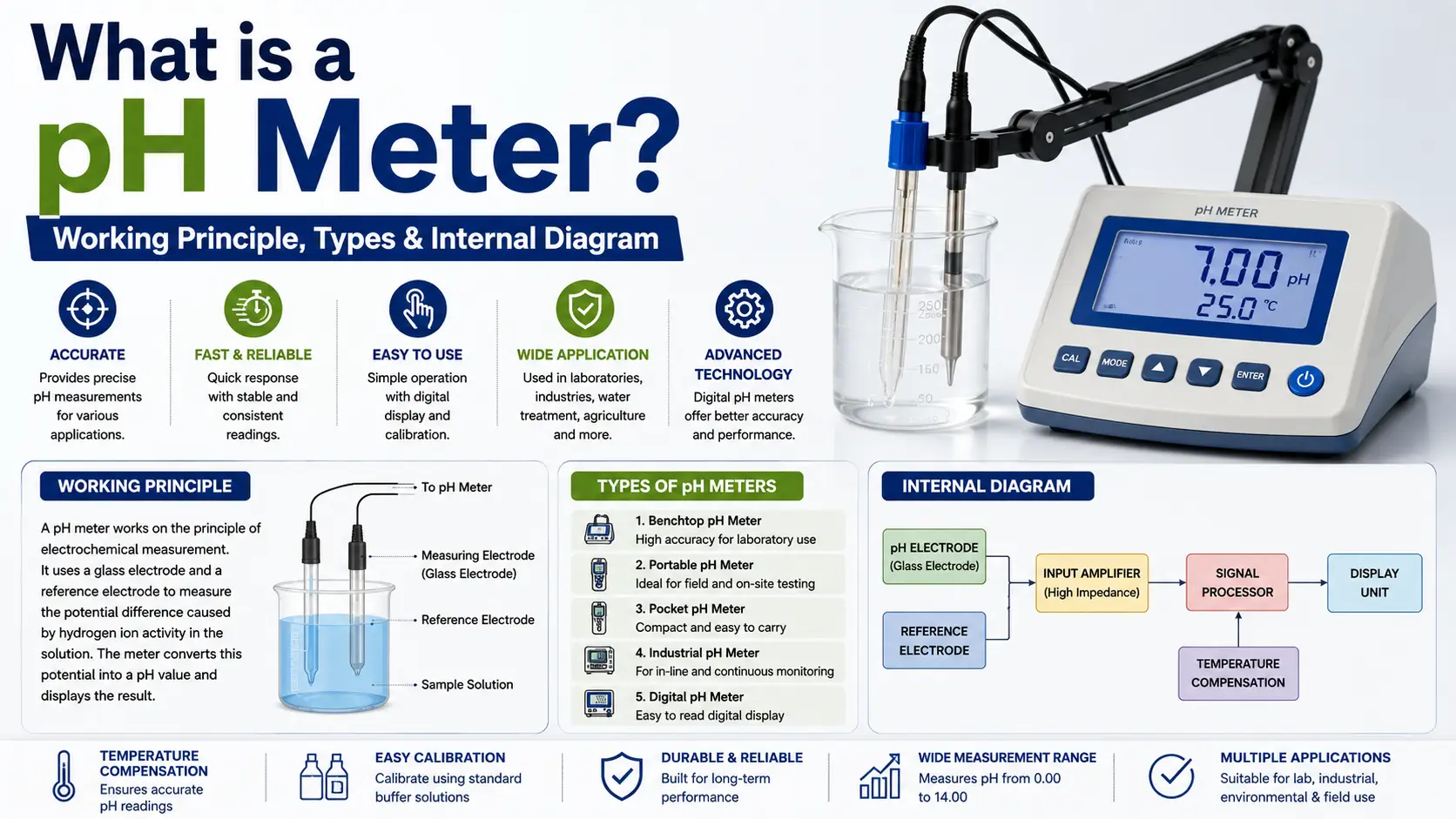
What is a pH Meter? Working Principle, Types & Internal Diagram
Introduction
A pH Meter is a scientific instrument used to measure the acidity or alkalinity of a solution. It provides accurate pH values by detecting the concentration of hydrogen ions present in a liquid. pH meters are widely used in laboratories, water treatment plants, pharmaceutical industries, food processing units, agriculture, and research institutions for quality control and analysis.
Compared to pH paper or indicator solutions, a pH meter offers precise and reliable measurements, making it an essential tool in modern analytical and industrial applications.
What is a pH Meter?
A pH meter is an electronic device that measures the pH level of a solution. The pH scale ranges from 0 to 14, where:
- pH less than 7 = Acidic
- pH equal to 7 = Neutral
- pH greater than 7 = Alkaline (Basic)
The instrument uses specialized electrodes to determine the hydrogen ion activity in a sample and displays the pH value digitally.
pH Meter Internal Diagram
A typical pH meter consists of the following components:
_______________________
| |
| pH METER |
|_______________________|
|
|
__________________
| |
| pH Electrode |
|__________________|
|
|
__________________
| |
| Sample Solution |
|__________________|
Main Components
1. Measuring Electrode (Glass Electrode)
Detects hydrogen ion concentration in the solution.
2. Reference Electrode
Provides a stable reference voltage for accurate measurement.
3. Temperature Sensor
Compensates for temperature variations affecting pH readings.
4. Amplifier Circuit
Converts weak electrode signals into readable values.
5. Digital Display
Shows the measured pH value.
Working Principle of a pH Meter
A pH meter operates on the principle of electrochemical measurement. The glass electrode develops an electrical potential when immersed in a solution. This potential changes according to the hydrogen ion concentration of the sample.
The meter measures the voltage difference between the measuring electrode and the reference electrode and converts it into a pH value.
Working Process
-
The electrode is immersed in the sample solution.
-
Hydrogen ions interact with the glass membrane.
-
An electrical potential is generated.
-
The reference electrode provides a stable comparison point.
-
The meter measures the voltage difference.
-
The electronic circuit converts the signal into a pH value.
-
The result appears on the digital display.
This process provides fast and highly accurate measurements.
Components of a pH Meter
Glass Electrode
The glass electrode is the most important part of the pH meter. It responds to hydrogen ion activity and generates an electrical signal proportional to the pH level.
Reference Electrode
Maintains a constant electrical potential, ensuring measurement stability.
Temperature Compensation System
Since pH readings can vary with temperature, modern pH meters include automatic temperature compensation (ATC) for improved accuracy.
Display Unit
Displays pH readings clearly and accurately.
Calibration Controls
Allow the instrument to be calibrated using standard buffer solutions.
Types of pH Meters
1. Benchtop pH Meter
These laboratory-grade instruments provide highly accurate measurements and are commonly used in research laboratories, educational institutions, and quality control departments.
Features:
- High precision
- Advanced calibration options
- Large display screen
- Suitable for laboratory use
2. Portable pH Meter
Portable pH meters are compact and battery-operated, making them ideal for field testing.
Applications:
- Water testing
- Environmental monitoring
- Agriculture
- Aquaculture
3. Pocket pH Meter
Pocket pH meters are small handheld devices designed for quick and convenient pH measurements.
Advantages:
- Lightweight
- Easy to carry
- Affordable
- Suitable for routine testing
4. Industrial pH Meter
Industrial pH meters are installed directly in processing systems for continuous monitoring.
Applications:
- Water treatment plants
- Chemical industries
- Pharmaceutical manufacturing
- Food processing industries
5. Digital pH Meter
Digital pH meters provide accurate readings through electronic circuitry and digital displays.
Benefits:
- Easy operation
- Fast results
- High accuracy
- Reliable performance
pH Scale Chart
|
pH Value |
Nature of Solution |
|
0 – 3 |
Strongly Acidic |
|
4 – 6 |
Weakly Acidic |
|
7 |
Neutral |
|
8 – 10 |
Weakly Alkaline |
|
11 – 14 |
Strongly Alkaline |
Understanding the pH scale helps users interpret solution characteristics accurately.
Applications of pH Meters
Water Treatment
Used to monitor drinking water, wastewater, and industrial water systems.
Pharmaceutical Industry
Ensures product quality and compliance with manufacturing standards.
Food and Beverage Industry
Measures acidity levels during production and quality control.
Agriculture
Analyzes soil and irrigation water to improve crop productivity.
Chemical Industry
Monitors chemical reactions and maintains process consistency.
Environmental Testing
Evaluates water quality in rivers, lakes, and environmental samples.
Research Laboratories
Supports scientific experiments and analytical studies.
Advantages of Using a pH Meter
High Accuracy
Provides precise measurements compared to pH indicator papers.
Fast Results
Delivers instant readings for efficient testing.
Easy Calibration
Can be calibrated using standard buffer solutions.
Wide Application Range
Suitable for laboratory, industrial, and field applications.
Digital Display
Easy-to-read results reduce interpretation errors.
Reliable Performance
Produces consistent and repeatable measurements.
Factors Affecting pH Measurements
Several factors can influence pH meter accuracy:
- Temperature variations
- Dirty electrodes
- Improper calibration
- Electrode aging
- Sample contamination
Regular maintenance helps maintain measurement accuracy.
Maintenance Tips for pH Meters
To ensure reliable operation:
- Clean electrodes regularly.
- Store electrodes in appropriate storage solution.
- Calibrate frequently using buffer solutions.
- Avoid touching the glass bulb.
- Replace damaged electrodes when necessary.
- Follow manufacturer maintenance guidelines.
Proper care significantly extends the lifespan of the instrument.
Importance of Calibration
Calibration ensures that the pH meter provides accurate results.
Common calibration buffers include:
- pH 4.00
- pH 7.00
- pH 10.00
- Regular calibration is recommended before critical measurements.
Conclusion
A pH meter is an essential analytical instrument used to measure the acidity or alkalinity of liquids with high accuracy. By utilizing electrochemical principles and specialized electrodes, it provides fast and reliable pH measurements for laboratories, industries, environmental testing, agriculture, pharmaceuticals, and water treatment applications.
Understanding the working principle, components, types, and maintenance requirements of a pH meter helps users obtain accurate results and ensure effective process control. Whether used in research laboratories or industrial facilities, a pH meter remains one of the most important tools for quality testing and scientific analysis.