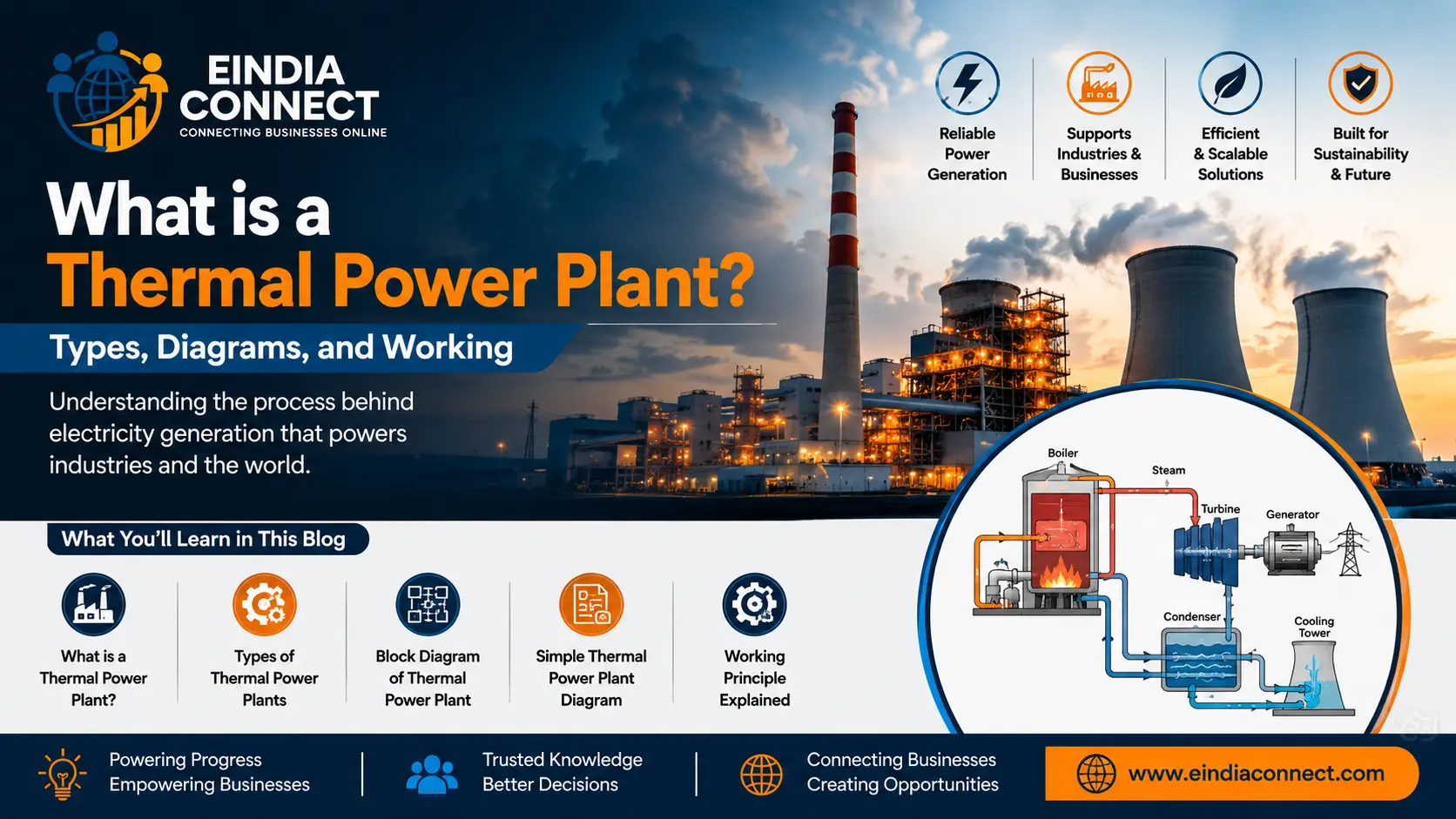
What is a Thermal Power Plant? Types, Diagrams, and Working
Electricity drives the wheels of industrial activity, commercial operations, domestic usage, and infrastructural activities in the modern age. Among the multiple means of electricity production, thermal power plants form one of the most popular sources of electricity all around the world. A thermal power plant involves the conversion of heat energy into electrical energy.
It is necessary for industries, power generating organizations, equipment manufacturers, and engineering firms listed on E India Connect to know about thermal power plants because that would help them recognize business and industry-related opportunities. In this blog post, we are going to find out about thermal power plants, their mechanism, important parts, various forms, and the significance of thermal power plant diagrams.
What is a Thermal Power Plant?
A thermal power plant is a facility that generates electricity by converting heat energy into electrical energy. The heat is typically produced by burning fossil fuels such as coal, natural gas, or oil. The generated heat is used to produce high-pressure steam, which drives a turbine connected to an electrical generator.
The electricity generated is then transmitted through power grids for residential, commercial, and industrial use. Thermal power plants continue to play a crucial role in meeting global energy demands because of their large-scale electricity generation capabilities and reliable operation.
Basic Principle of a Thermal Power Plant
The working principle of a thermal power plant is based on the Rankine Cycle. In this process:
-
Fuel is burned in a boiler.
-
Heat converts water into high-pressure steam.
-
Steam rotates a turbine.
-
The turbine drives a generator.
-
Electricity is produced and supplied to the grid.
-
Exhaust steam is condensed and recycled back into the boiler.
This continuous cycle enables efficient power generation on a large scale.
Major Components of a Thermal Power Plant
Understanding the major components helps in visualizing the block diagram of thermal power plant systems.
- Boiler- The boiler is responsible for generating steam by heating water using fuel combustion.
- Steam Turbine- The high-pressure steam produced in the boiler drives the turbine blades, converting thermal energy into mechanical energy.
- Generator- The turbine shaft is connected to a generator that converts mechanical energy into electrical energy.
- Condenser- The condenser cools and converts exhaust steam back into water for reuse.
- Cooling Tower- Cooling towers remove excess heat from the condenser and improve overall plant efficiency.
- Feed Water Pump- This pump transfers condensed water back to the boiler, completing the cycle.
- Coal Handling System- In coal-fired plants, the coal handling system manages fuel storage, transportation, and feeding into the boiler.
Block Diagram of Thermal Power Plant
A block diagram of thermal power plant helps engineers, students, and industry professionals understand the flow of energy and materials throughout the system.
A simplified flow can be represented as:
Fuel → Boiler → Steam → Turbine → Generator → Electricity
Simultaneously:
Steam → Condenser → Feed Water Pump → Boiler
This basic representation forms the foundation of most thermal power generation systems and is often used in engineering education and industrial training.
Thermal Power Plant Diagram
A thermal power plant diagram provides a detailed visual representation of various equipment and their interconnections.
A standard diagram typically includes:
-
Fuel handling system
-
Boiler
-
Superheater
-
Steam turbine
-
Generator
-
Condenser
-
Cooling tower
-
Feed water system
-
Chimney
-
Ash handling system
Such diagrams help operators understand plant operations, maintenance procedures, and troubleshooting requirements.
Simple Thermal Power Plant Diagram
For beginners, a simple thermal power plant diagram is often used to explain the basic working process without excessive technical complexity.
The simplified arrangement generally includes:
-
Fuel source
-
Boiler
-
Turbine
-
Generator
-
Condenser
This approach makes it easier for students, business professionals, and non-technical audiences to understand the electricity generation process.
A thermal power plant diagram simple version is frequently used in training manuals, presentations, and educational materials because it focuses on the core components involved in power production.
Working of a Thermal Power Plant
The operation of a thermal power plant involves several interconnected stages.
Step 1: Fuel Combustion- Coal, natural gas, oil, or other fuels are burned inside the boiler furnace. The combustion process generates a large amount of heat.
Step 2: Steam Generation- The heat produced converts water into high-pressure steam. The steam is often superheated to improve efficiency.
Step 3: Turbine Operation- The high-pressure steam is directed onto turbine blades. As the steam expands, it causes the turbine to rotate at high speed.
Step 4: Electricity Generation- The rotating turbine shaft drives the generator. Through electromagnetic induction, electrical energy is produced.
Step 5: Condensation- After passing through the turbine, the steam enters the condenser, where it is cooled and converted back into water.
Step 6: Water Recirculation- The condensed water is pumped back to the boiler for reuse, creating a continuous cycle.
This systematic process ensures uninterrupted electricity generation.
Types of Thermal Power Plants
Different thermal power plants are classified based on the fuel used and operational technology.
Coal-Fired Thermal Power Plants
These are the most common type of thermal power plants. Coal is burned to generate heat for steam production.
Advantages:
-
Large-scale power generation
-
Reliable operation
-
Established technology
Gas-Fired Thermal Power Plants
These plants use natural gas as fuel.
Benefits include:
-
Lower emissions
-
Faster startup times
-
Higher efficiency
Oil-Fired Thermal Power Plants
Fuel oil is used for combustion and steam generation. These plants are generally used where coal or gas supplies are limited.
Combined Cycle Power Plants
Combined cycle systems use both gas turbines and steam turbines to maximize efficiency.
Advantages:
-
Improved fuel utilization
-
Lower operating costs
-
Reduced emissions
Biomass Thermal Power Plants
Agricultural waste, wood chips, and organic materials are used as fuel sources. These plants support renewable energy goals and sustainability initiatives.
Importance of Thermal Power Plant Diagrams
A diagram of thermal power plants serves multiple purposes across industries.
- Training and Education- Engineering students and technical trainees use diagrams to understand plant operation and equipment functions.
- Plant Design- Engineers rely on detailed diagrams during planning, construction, and expansion projects.
- Maintenance Activities- Maintenance teams use plant diagrams to identify equipment locations and system interconnections.
- Operational Efficiency- Operators can monitor process flow and optimize performance using system diagrams.
Because of these benefits, thermal power plant diagrams remain essential tools for engineers and plant managers.
Advantages of Thermal Power Plants
Thermal power plants continue to play a significant role in power generation because they offer:
-
Reliable electricity production
-
Large generation capacity
-
Continuous operation
-
Established technology
-
Flexible fuel options
-
Support for industrial growth
Many developing economies still depend heavily on thermal power generation to meet increasing electricity demands.
Challenges Faced by Thermal Power Plants
Despite their importance, thermal power plants face several challenges:
-
Fuel supply fluctuations
-
Environmental concerns
-
Carbon emissions
-
Water consumption
-
Ash disposal requirements
-
Regulatory compliance pressures
To address these issues, modern plants are adopting cleaner technologies and efficiency improvement measures.
Future of Thermal Power Generation
The thermal power sector is evolving rapidly with advancements in technology.
Emerging trends include:
-
High-efficiency boilers
-
Carbon capture systems
-
Waste heat recovery
-
Digital monitoring solutions
-
Artificial intelligence-based plant optimization
-
Cleaner fuel integration
These innovations aim to improve efficiency while reducing environmental impact.
Conclusion
The thermal power plant is still one of the most significant sources for generating electricity in the world. They provide industries, businesses, and houses with a constant source of electricity using various processes that transform heat energy into electrical energy.
Knowledge about such things as thermal power plant diagram, thermal power plant diagram simple, block diagram of thermal power plant, simple thermal power plant diagram, and diagram of thermal power plant provides useful information on electric generation systems.
The thermal power plants are going to play an important role in the future despite the changes in the energy sector.