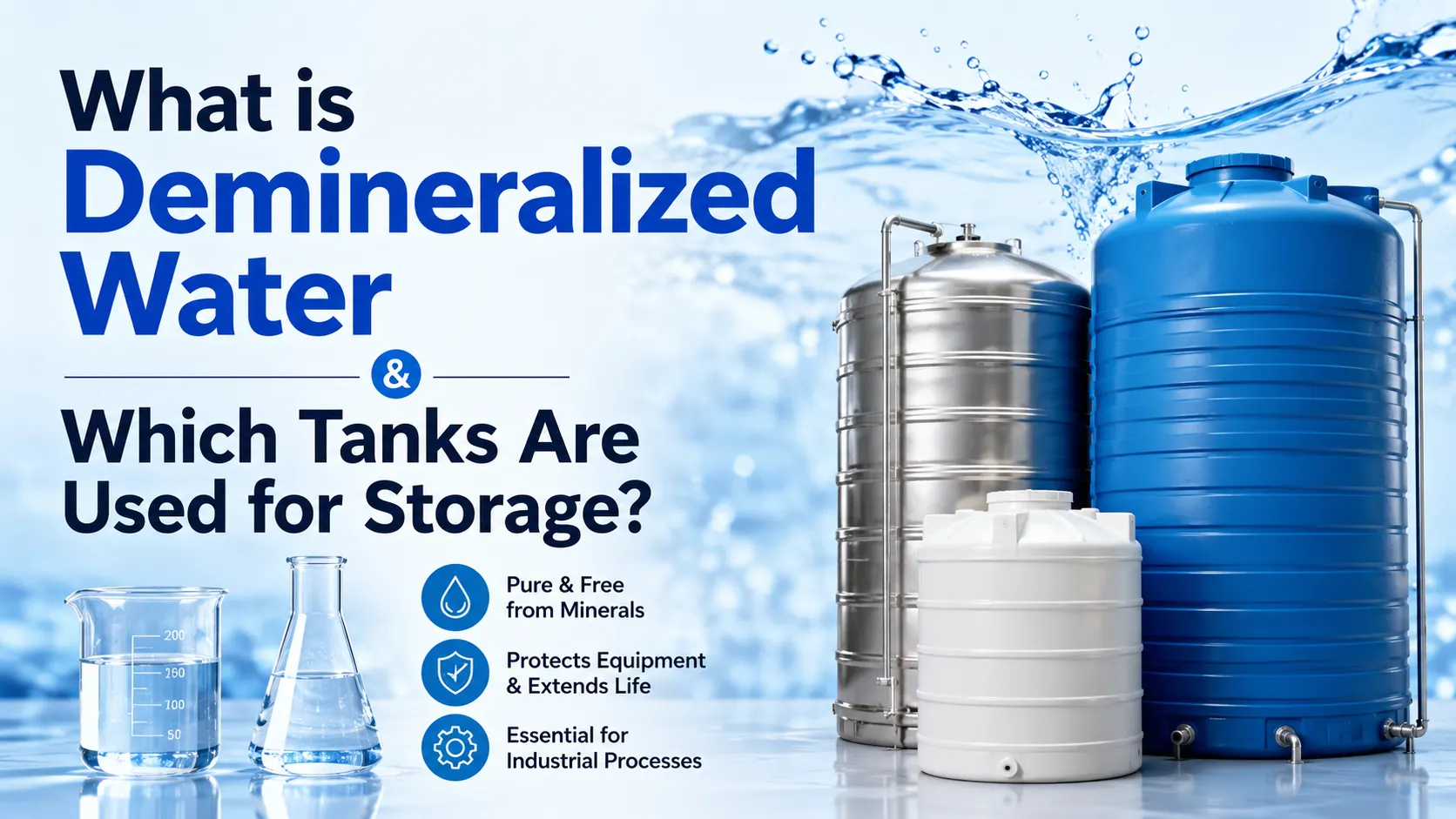
What is Demineralized Water & Which Tanks Are Used for Storage?
In today’s industrial world, water quality plays a critical role in ensuring smooth operations and maintaining equipment efficiency. One type of purified water that is widely used across various industries is demineralized water. Industries such as pharmaceuticals, power generation, food processing, chemicals, and laboratories rely on this highly purified water for their daily operations.
As a trusted B2B Portal and Marketplace, E India Connect helps businesses connect with reliable suppliers and manufacturers who offer and provide high-quality water treatment solutions, storage tanks, and industrial equipment.
What is Demineralised Water?
Demineralised water is water that has had most of its dissolved minerals and salts removed through specialized purification processes. Minerals such as calcium, magnesium, sodium, potassium, chloride, sulfate, and bicarbonates are extracted to produce highly purified water.
The process of creating demineralised water typically involves technologies such as:
- Ion Exchange
- Reverse Osmosis (RO)
- Electrodeionization (EDI)
- Mixed Bed Resin Treatment
The resulting water contains extremely low levels of dissolved solids, making it suitable for applications where water purity is essential.
Industries use demineralised water because minerals present in normal water can cause scaling, corrosion, deposits, and contamination that may affect machinery performance and product quality.
Why is Demineralised Water Important?
The use of demineralised water offers several advantages across industrial applications.
- Prevents Scale Formation: Minerals in untreated water can accumulate inside pipes, boilers, and heat exchangers. Demineralized water eliminates this issue and helps maintain system efficiency.
- Reduces Corrosion: Impurities and dissolved salts can contribute to corrosion in industrial equipment. Using purified water extends the lifespan of machinery.
- Improved Product Quality: Industries such as pharmaceuticals and electronics require extremely pure water to maintain product standards and consistency.
- Enhances Operational Efficiency: Equipment that operates with purified water generally experiences fewer maintenance issues and lower downtime.
- Supports Sensitive Processes: Many manufacturing and laboratory processes demand water free from contaminants and dissolved minerals.
Industries That Use Demineralised Water
Several industries depend on demineralised water for their operations, including:
- Power Plants
- Pharmaceutical Manufacturing
- Food and Beverage Processing
- Chemical Industries
- Textile Manufacturing
- Electronics Production
- Laboratories and Research Facilities
- Automotive Industries
In these sectors, water purity directly impacts productivity, safety, and product quality.
Which Tanks Are Used for Storage of Demineralised Water?
Proper storage is just as important as the purification process itself. Since demineralised water is highly pure, it can easily absorb contaminants from unsuitable storage materials. Therefore, selecting the correct storage tank is essential.
1. FRP Tanks (Fiber Reinforced Plastic)
FRP tanks are among the most commonly used storage solutions for demineralized water.
Benefits include:
- Corrosion resistance
- Lightweight construction
- Long service life
- Low maintenance requirements
- Excellent chemical resistance
These tanks are widely used in industrial facilities where water purity must be maintained.
2. HDPE Tanks (High-Density Polyethylene)
HDPE tanks are another popular option for storing demineralised water.
Advantages include:
- Non-toxic material
- UV resistance
- Durability
- Easy installation
- Cost-effectiveness
HDPE tanks are suitable for various industrial and commercial applications.
3. Stainless Steel Tanks
For industries that require the highest levels of purity, stainless steel tanks are often preferred.
Benefits include:
- Superior hygiene
- High corrosion resistance
- Long-term durability
- Smooth internal surfaces
- Suitable for pharmaceutical and food-grade applications
Stainless steel tanks are commonly found in industries where contamination control is critical.
4. Polypropylene (PP) Tanks
Polypropylene tanks are highly resistant to chemicals and are frequently used for storing purified water.
Key advantages include:
- Excellent chemical compatibility
- Lightweight design
- Resistance to corrosion
- Low maintenance
These tanks are often selected for specialized industrial environments.
Factors to Consider When Choosing a Storage Tank
When selecting a tank for demineralised water storage, businesses should consider several factors.
- Material Compatibility: The tank material should not react with purified water or release contaminants.
- Storage Capacity: Choose a tank size based on daily consumption and operational requirements.
- Environmental Conditions: Outdoor installations may require UV-resistant materials and additional protection.
- Maintenance Requirements: Easy-to-clean tanks help maintain water purity over time.
- Industry Standards: The storage system should comply with applicable industry regulations and quality requirements.
How Proper Storage Maintains Water Quality
Even after purification, demineralised water can become contaminated if stored improperly. Suitable storage tanks help:
- Prevent bacterial growth
- Minimize contamination
- Preserve water purity
- Protect industrial equipment
- Maintain process efficiency
Regular tank inspection and cleaning are also important to ensure long-term performance.
How E India Connect Helps Businesses
Finding reliable suppliers for water treatment systems and storage tanks can be challenging. E India Connect, a leading B2B Portal and Marketplace, simplifies this process by connecting buyers with trusted manufacturers and suppliers across India.
Through the platform, businesses can explore a wide range of industrial products, compare suppliers, and find solutions that match their requirements. E India Connect helps companies identify vendors who offer and provide quality storage tanks, water treatment plants, filtration systems, and related industrial equipment.
Conclusion
Demineralised water is an essential resource for industries that require high-purity water for manufacturing, processing, and operational efficiency. By removing dissolved minerals and salts, demineralized water helps prevent scaling, corrosion, and contamination while improving equipment performance and product quality.
To maintain this purity, proper storage is crucial. FRP tanks, HDPE tanks, stainless steel tanks, and polypropylene tanks are among the most widely used solutions for storing demineralised water safely and effectively. As a trusted B2B Portal and Marketplace, E India Connect helps businesses connect with suppliers who offer high-quality storage and water treatment solutions for various industrial needs.