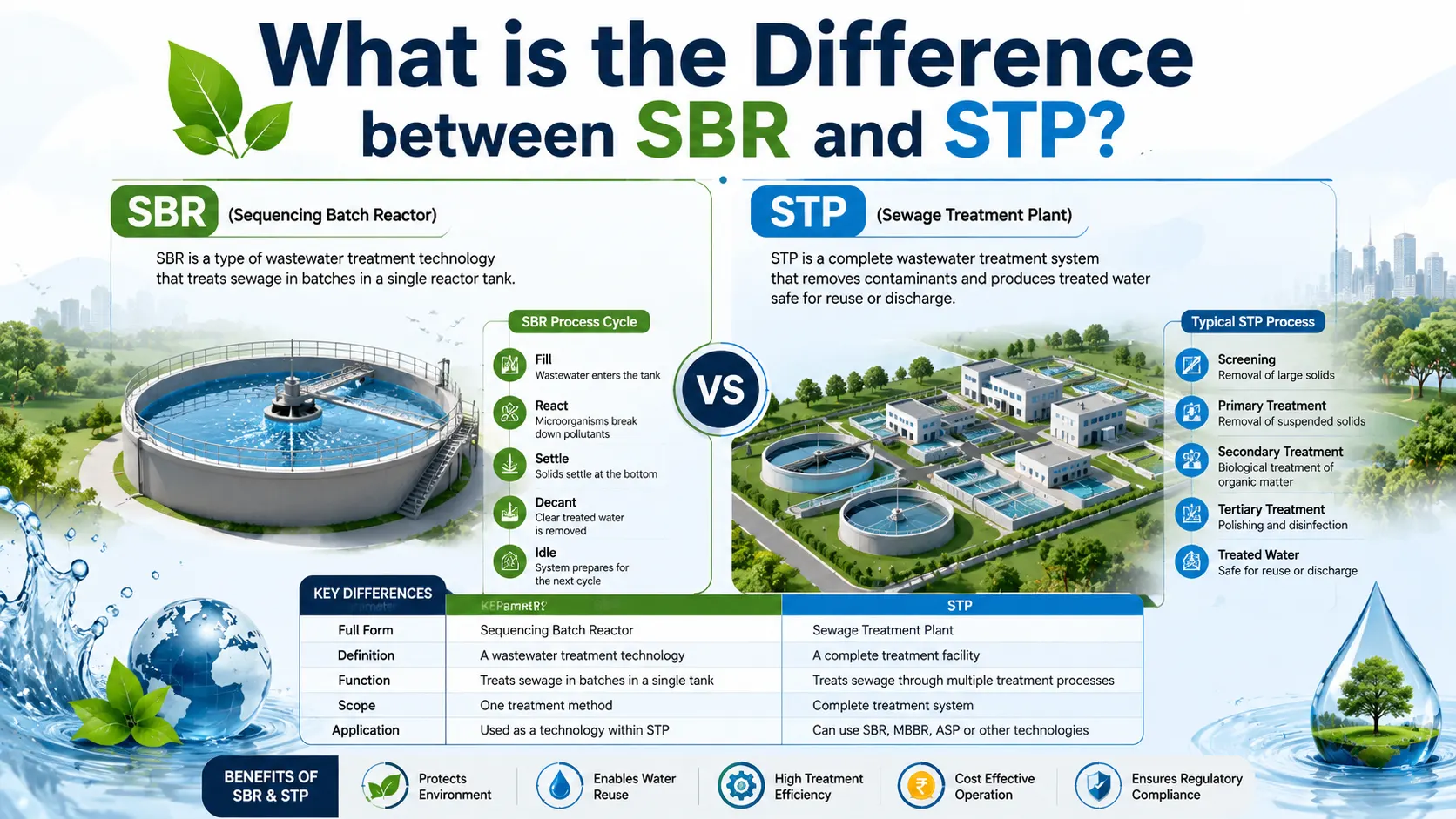
What is Difference between SBR and STP?
Among the various treatment methods available today, SBR and STP are two commonly discussed terms. Many people often search for the difference between these systems and wonder how they function in wastewater management.
As a leading B2B Portal and Marketplace, E India Connect helps buyers connect with trusted suppliers, manufacturers, and service providers across various industries, including water treatment and environmental solutions. Understanding the difference between SBR and STP can help businesses and organizations select the right wastewater treatment system for their specific needs.
What is STP?
Before comparing the two, it is important to understand the terminology. The STP full form is Sewage Treatment Plant. An STP is a facility designed to treat wastewater generated from residential, commercial, institutional, and industrial sources before it is discharged or reused.
STPs can use different treatment technologies, including Activated Sludge Process (ASP), Moving Bed Biofilm Reactor (MBBR), Membrane Bioreactor (MBR), and SBR systems.
What is SBR?
Many people search for sbr full form, sbr full form stp, sbr full form in stp, and sbr stp full form when learning about sewage treatment technologies.
The SBR full form is Sequencing Batch Reactor.
An SBR is not a separate treatment plant but rather a specific technology used within an STP. In simple terms, SBR is one of the advanced treatment methods used in modern sewage treatment plants.
How Does an SBR System Work?
An SBR system operates through several treatment stages:
- Fill Phase: Wastewater enters the reactor tank where biological treatment begins.
- React Phase: Microorganisms break down organic pollutants and contaminants.
- Settle Phase: The treated water is allowed to settle, separating solids from the clarified water.
- Decant Phase: Clean treated water is removed from the tank.
- Idle Phase: The system prepares for the next treatment cycle.
Because all these stages occur in a single reactor, SBR technology offers excellent treatment efficiency while reducing the need for multiple tanks.
Difference Between SBR and STP
The most common misunderstanding is assuming that SBR and STP are competing technologies. In reality, they are not.
|
Feature |
SBR |
STP |
|
Full Form |
Sequencing Batch Reactor |
Sewage Treatment Plant |
|
Definition |
A wastewater treatment technology |
A complete sewage treatment facility |
|
Function |
Performs biological treatment of sewage |
Treats sewage using various technologies |
|
Scope |
One treatment method |
Entire treatment system |
|
Application |
Used as a component within an STP |
Can use SBR, MBBR, ASP, or other technologies |
Advantages of SBR Technology
SBR systems have gained popularity because of several operational advantages.
- High Treatment Efficiency: SBR technology effectively removes organic pollutants, suspended solids, and nutrients from wastewater.
- Compact Design: Since multiple treatment stages occur in a single tank, less space is required compared to traditional treatment systems.
- Flexible Operation: SBR systems can handle fluctuations in wastewater flow and pollutant load more efficiently.
- Lower Infrastructure Requirements: The use of fewer tanks reduces construction costs and simplifies plant design.
- Better Water Quality: The treated water produced by SBR systems often meets stringent environmental standards for discharge and reuse.
Advantages of STP Systems
A properly designed STP provides several important benefits.
- Environmental Protection: STPs prevent untreated sewage from entering rivers, lakes, and groundwater sources.
- Water Reuse: Treated wastewater can be reused for landscaping, irrigation, cooling towers, and industrial applications.
- Regulatory Compliance: STPs help organizations comply with environmental regulations and wastewater discharge standards.
- Improved Public Health: Proper sewage treatment reduces the spread of waterborne diseases and environmental contamination.
Where is SBR Technology Commonly Used?
Because of its efficiency and compact design, SBR technology is widely used in:
- Residential complexes
- Hotels and resorts
- Hospitals
- Educational institutions
- Commercial buildings
- Industrial facilities
- Municipal sewage treatment projects
Many modern wastewater treatment projects prefer SBR systems because they offer reliable performance with relatively low operational complexity.
Understanding the difference between SBR and STP is essential when evaluating wastewater treatment solutions. While the sbr full form is Sequencing Batch Reactor, the STP full form is Sewage Treatment Plant. An STP is a complete treatment facility, whereas SBR is a specific treatment technology used within an STP.
As wastewater management becomes increasingly important, advanced technologies such as SBR continue to play a vital role in improving treatment efficiency and water reuse. Through its role as a leading B2B Portal and Marketplace, E India Connect offers valuable connections between buyers and suppliers, helping organizations find the right wastewater treatment solutions for sustainable operations.