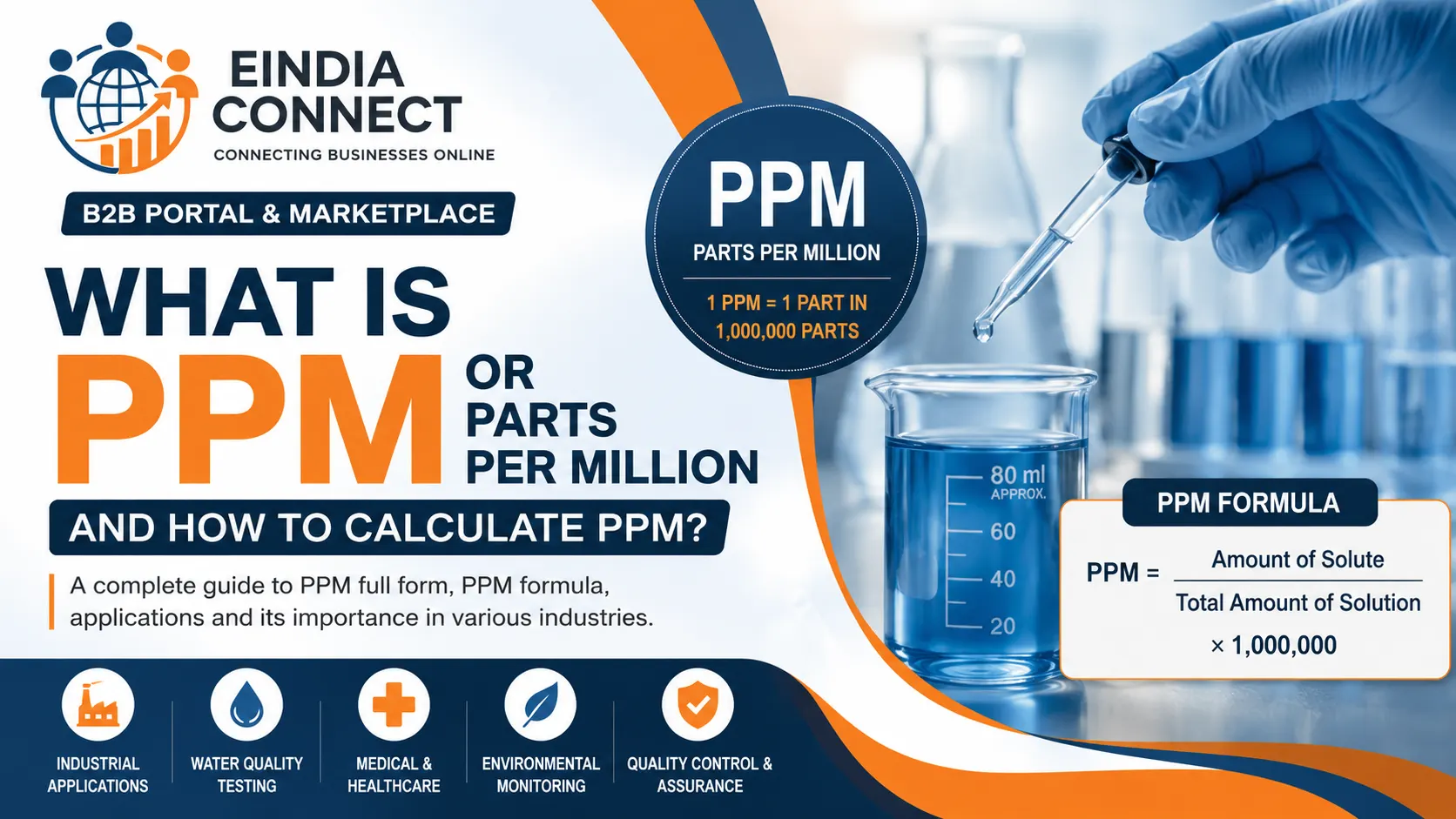
What is PPM or Parts Per Million and How to Calculate PPM?
In manufacturing, water treatment, healthcare, pharmaceuticals, agriculture, food processing, and environmental monitoring, accuracy matters a ton. For tiny concentration measurements, parts per million (PPM) is super common. You need to grasp PPM for quality control, product testing, lab analysis, and running plants smoothly – it's that important.
For anyone in manufacturing, supplying, researching, or working in business, understanding PPM is key to making good decisions and keeping up with industry standards. E India Connect, a top B2B Portal and Marketplace, connecting buyers, suppliers, manufacturers, and service providers across India, knows how crucial this tech knowledge is for business growth and excellence in industries across the country.
In this blog, we will explain the PPM full form, its applications, calculation methods, and why it plays a crucial role across multiple industries.
What is the PPM Full Form?
The PPM full form is Parts Per Million. PPM is a unit used to measure extremely small concentrations of a substance within a larger mixture. It indicates how many parts of a particular substance are present in one million parts of the total solution or material.
For example:
- 1 PPM means 1 part of a substance in 1,000,000 parts of the total mixture.
- 10 PPM means 10 parts of a substance in 1,000,000 parts of the mixture.
- 100 PPM means 100 parts of a substance in 1,000,000 parts of the mixture.
Because PPM represents very small quantities, it is widely used in laboratory testing, environmental monitoring, water quality analysis, and industrial manufacturing.
Why is PPM Important?
PPM helps businesses and industries measure trace amounts of chemicals, contaminants, minerals, or impurities with high precision.
Some common applications include:
- Water quality testing
- Air pollution monitoring
- Chemical manufacturing
- Pharmaceutical production
- Food processing
- Agriculture and fertilizers
- Medical laboratories
- Industrial quality control
By measuring substances in PPM, organizations can ensure compliance with safety regulations and maintain product quality standards.
Understanding Parts Per Million
To better understand PPM, imagine a container holding one million marbles. If only one marble is red and the remaining marbles are white, the concentration of red marbles would be 1 PPM.
This simple concept helps explain why PPM is useful when dealing with very low concentrations that cannot easily be expressed as percentages.
For comparison:
- 1% = 10,000 PPM
- 0.1% = 1,000 PPM
- 0.01% = 100 PPM
- 0.001% = 10 PPM
This level of precision makes PPM particularly valuable in scientific and industrial applications.
PPM Formula
The standard PPM formula is:
PPM = (Amount of Solute / Total Amount of Solution) × 1,000,000
Where:
- Solute = Substance being measured
- Solution = Total mixture or sample
- 1,000,000 = Conversion factor
The PPM formula allows users to calculate the concentration of a specific substance within a larger sample accurately.
How to Calculate PPM?
Calculating PPM is relatively straightforward when the quantity of the substance and total solution are known.
Example 1: Water Testing
Suppose 2 grams of a chemical are present in 1,000,000 grams of water.
PPM = (2 / 1,000,000) × 1,000,000
PPM = 2
The concentration is 2 PPM.
Example 2: Industrial Solution
If 50 mg of a substance is present in 1 liter of water:
PPM = 50 mg/L
Since 1 mg/L is approximately equal to 1 PPM in water, the concentration is:
50 PPM
This method is commonly used in water treatment and environmental testing.
Common Methods for Measuring PPM
Different industries use specialized instruments to measure PPM levels accurately.
Popular measurement methods include:
- Spectrophotometers
- Water testing kits
- Gas analyzers
- Laboratory chemical analysis
- Digital TDS meters
- Environmental monitoring equipment
These tools help ensure accurate readings for industrial and scientific applications.
PPM in Water Quality Testing
Water quality testing is one of the most common applications of PPM measurement. Various dissolved substances such as minerals, salts, and contaminants are measured in PPM.
Examples include:
- Total Dissolved Solids (TDS)
- Chlorine concentration
- Fluoride levels
- Iron content
- Nitrate concentration
Maintaining acceptable PPM levels helps ensure safe drinking water and effective industrial water treatment processes.
PPM in Manufacturing and Quality Control
Manufacturing industries rely heavily on PPM measurements to monitor product quality and process efficiency.
PPM is commonly used for:
- Defect rate analysis
- Product consistency monitoring
- Raw material testing
- Process control
- Quality assurance programs
For example, a manufacturing company may measure defective products in PPM to determine process performance and identify areas for improvement.
PPM in Environmental Monitoring
Environmental agencies and industries use PPM to monitor pollutants and maintain regulatory compliance.
Applications include:
- Air quality assessment
- Soil contamination analysis
- Industrial emissions monitoring
- Wastewater treatment
- Groundwater testing
Accurate PPM measurements help organizations minimize environmental impact and comply with government regulations.
PPM Full Form in Medical Field
Many people search for the PPM full form in medical terminology. In healthcare and laboratory applications, PPM generally still stands for Parts Per Million when referring to concentrations of chemicals, gases, minerals, or biological substances.
Medical laboratories use PPM measurements in:
- Blood analysis
- Toxicology testing
- Drug concentration monitoring
- Oxygen and gas measurements
- Laboratory research
However, in some medical contexts, abbreviations may have different meanings depending on the specific field or specialty. Therefore, it is always important to interpret medical abbreviations within their intended context.
Advantages of Using PPM
PPM is widely accepted because it provides a simple and precise way to express very small concentrations.
Key benefits include:
- Easy comparison of concentration levels
- High measurement accuracy
- Suitable for scientific analysis
- Useful for quality control
- Standardized across industries
- Effective for environmental monitoring
These advantages make PPM one of the most important measurement units in modern industry and science.
Common Industries Using PPM Measurements
Numerous sectors depend on PPM calculations for daily operations.
These industries include:
- Pharmaceuticals
- Chemicals
- Water treatment
- Food and beverages
- Agriculture
- Manufacturing
- Healthcare
- Environmental services
- Mining
- Petrochemicals
As industries continue to adopt stricter quality standards, the importance of PPM measurement continues to grow.
How E India Connect Supports Industrial Businesses
E India Connect is a trusted B2B Portal and Marketplace. It links manufacturers, suppliers, exporters, traders, and service providers with potential buyers in various industries. The site lets businesses find products, services, machinery, and industrial solutions, along with industry-specific info for smart decisions.
By sharing educational resources and industry insights, E India Connect aims to bridge the gap between buyers and suppliers while promoting business growth and technological awareness.
Conclusion
The PPM full form is Parts Per Million, a measurement unit used to express very small concentrations within a larger mixture. Whether in water testing, manufacturing, pharmaceuticals, environmental monitoring, or healthcare, understanding the PPM formula and calculation process is essential for maintaining quality, safety, and compliance.
The PPM full form in medical and industrial applications generally refers to the same concept of measuring trace concentrations accurately. As industries increasingly focus on precision and quality control, PPM remains one of the most valuable measurement standards used worldwide.
Understanding how to calculate and interpret PPM can help businesses improve processes, maintain regulatory compliance, and make better operational decisions in today's competitive marketplace.