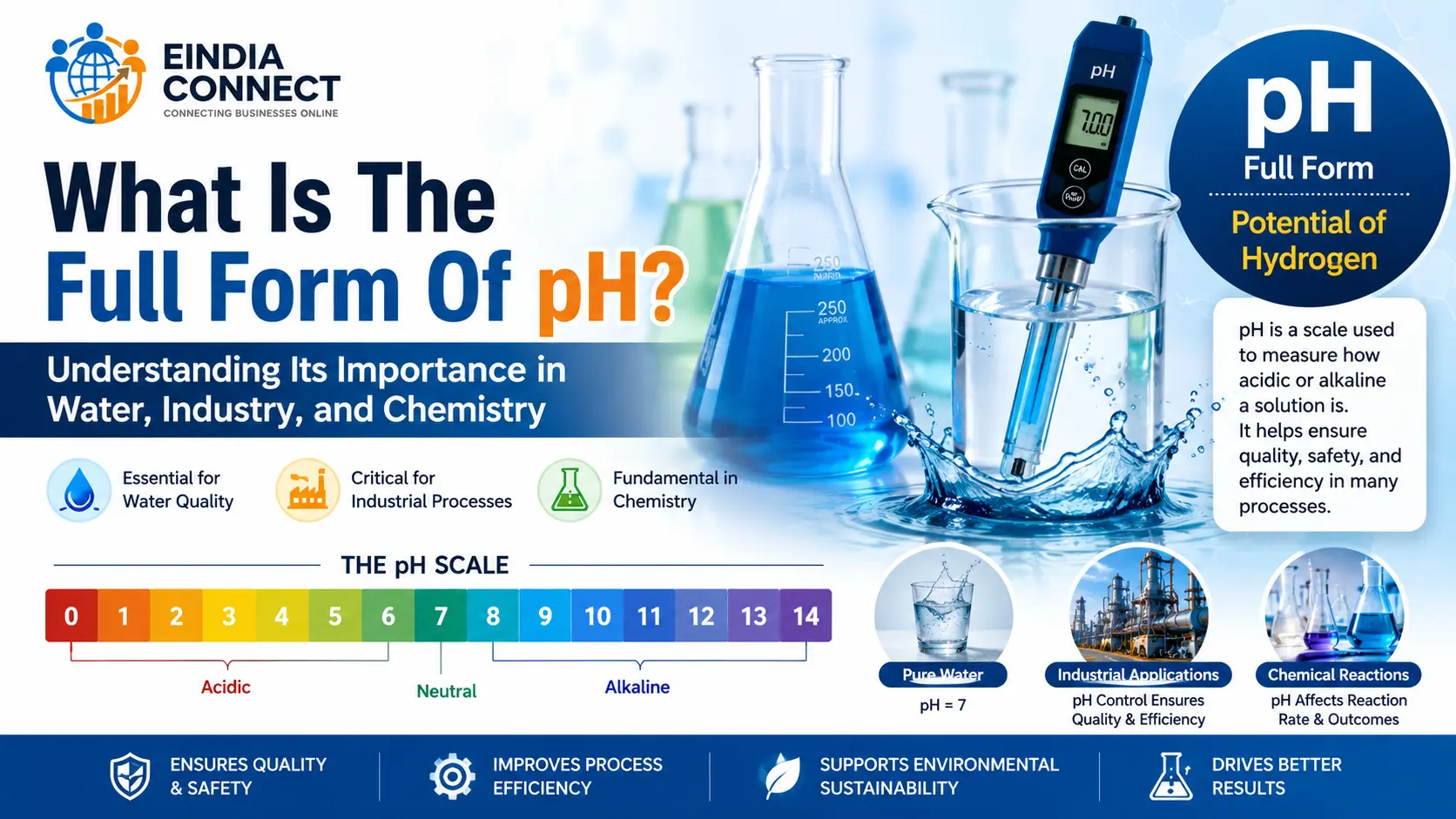
What Is The Full Form Of pH? Understanding Its Importance in Water, Industry, and Chemistry
The term pH is commonly used in science, water treatment, agriculture, healthcare, manufacturing, and various industrial processes. Whether you are testing drinking water, monitoring wastewater, manufacturing chemicals, or managing an industrial process, understanding pH is essential.
Many people search for the pH full form, full form of pH, pH full form water, and pH full form in chemistry to understand what this important measurement actually means. In this article, we will explain the meaning of pH, its importance, how it is measured, and why businesses across multiple industries rely on pH monitoring for quality control and operational efficiency.
What Is The Full Form Of pH?
The pH full form is Potential of Hydrogen. In scientific terms, pH is a scale used to measure the acidity or alkalinity of a solution. It indicates the concentration of hydrogen ions (H⁺) present in water or any liquid.
The full form of pH helps determine whether a substance is acidic, neutral, or alkaline. The pH scale ranges from 0 to 14:
- pH less than 7 = Acidic
- pH equal to 7 = Neutral
- pH greater than 7 = Alkaline (Basic)
For example:
- Lemon juice has a pH of around 2.
- Pure water has a pH of 7.
- Soap solutions often have a pH between 9 and 11.
Understanding pH is crucial because even small changes in pH levels can significantly impact chemical reactions, product quality, and environmental safety.
pH Full Form in Chemistry
When discussing the pH full form in chemistry, it refers to the measurement of hydrogen ion concentration in a solution.
Chemists use pH to understand how substances react with each other. Many chemical reactions occur efficiently only within a specific pH range.
In chemistry laboratories, pH is used for:
- Acid-base analysis
- Chemical manufacturing
- Laboratory testing
- Pharmaceutical production
- Research and development
The pH value provides important information about the chemical properties of a substance and helps scientists maintain process accuracy.
pH Full Form Water: Why Is It Important?
One of the most common searches is pH full form water because water quality directly affects human health, industrial operations, and environmental sustainability.
Water with an improper pH level can cause several problems:
Drinking Water Quality
Safe drinking water generally has a pH between 6.5 and 8.5. Water outside this range may:
- Affect taste
- Corrode pipelines
- Damage plumbing systems
- Reduce water quality
Industrial Water Systems
Industries use pH monitoring to protect equipment and maintain production standards.
Improper water pH can lead to:
- Corrosion
- Scaling
- Reduced equipment life
- Process inefficiencies
Wastewater Treatment
Wastewater treatment plants continuously monitor pH levels to ensure environmental compliance before releasing treated water.
How Does the pH Scale Work?
The pH scale measures the concentration of hydrogen ions in a solution.
The lower the pH value:
- The more acidic the solution.
The higher the pH value:
- The more alkaline the solution.
Common pH Values
| Substance | Approximate pH Value |
|---|---|
| Battery Acid | 0-1 |
| Lemon Juice | 2 |
| Vinegar | 3 |
| Coffee | 5 |
| Pure Water | 7 |
| Sea Water | 8 |
| Baking Soda Solution | 9 |
| Soap Solution | 10-11 |
| Bleach | 12-13 |
This scale helps industries and laboratories quickly identify the chemical nature of various liquids.
How Is pH Measured?
Several methods are used to measure pH levels.
pH Meter
A pH meter is the most accurate method for determining pH values.
It consists of:
- Sensor electrode
- Digital display
- Calibration system
pH meters are widely used in laboratories and industrial facilities.
pH Indicator Paper
This method involves dipping special paper into a solution. The paper changes color depending on the pH value.
Digital Water Testing Instruments
Modern industries use advanced digital monitoring systems for real-time pH measurement and process control.
Industries Where pH Monitoring Is Important
The importance of pH extends far beyond laboratories.
Water Treatment Industry
Water treatment facilities continuously monitor pH levels to ensure safe water quality.
Chemical Manufacturing
Chemical manufacturers rely on pH control for consistent product quality and process efficiency.
Food and Beverage Industry
pH affects taste, preservation, and food safety.
Pharmaceutical Industry
Many medicines require strict pH control during production.
Agriculture
Soil pH directly impacts crop growth and nutrient absorption.
Textile Industry
Textile processing and dyeing operations depend heavily on proper pH management.
Wastewater Treatment Plants
Environmental regulations require treated wastewater to meet specific pH standards before discharge.
Why pH Matters in Industrial Operations
For businesses, maintaining the correct pH level is essential for:
Product Quality
Many products require precise pH levels to achieve desired characteristics.
Equipment Protection
Improper pH can cause:
- Corrosion
- Pipe damage
- Equipment failure
Process Efficiency
Correct pH levels help optimize industrial processes and reduce operational costs.
Regulatory Compliance
Many industries must comply with environmental and quality regulations related to pH control.
The Role of pH in B2B Industries
As a growing B2B marketplace, E India Connect connects buyers and suppliers across industries that frequently deal with pH-related products and services.
Businesses often source:
- Water treatment plants
- pH meters
- Laboratory instruments
- Chemical dosing systems
- Wastewater treatment equipment
- Industrial chemicals
- Testing and monitoring solutions
Understanding pH helps businesses make informed purchasing decisions and select the right products for their operational needs.
Common Misconceptions About pH
pH Only Applies to Water
This is incorrect.
pH can be measured in many liquids, including chemicals, food products, beverages, industrial solutions, and laboratory samples.
Neutral Water Is Always Safe
Not necessarily.
While pH is important, water quality also depends on factors such as contaminants, dissolved solids, and microbial content.
High pH Is Better Than Low pH
Neither is universally better.
The ideal pH depends on the specific application and industry requirements.
Future Importance of pH Monitoring
As industries move toward automation and sustainability, pH monitoring is becoming increasingly important.
Advanced technologies now allow:
- Real-time monitoring
- Automated process control
- Remote data analysis
- Improved operational efficiency
These innovations help industries reduce waste, improve product quality, and meet environmental regulations.
Conclusion
The pH full form is Potential of Hydrogen, and it is one of the most important measurements used in science, water treatment, chemistry, manufacturing, and industrial operations. Understanding the full form of pH, pH full form water, and pH full form in chemistry helps businesses and individuals better understand water quality, chemical behavior, and process efficiency.
From drinking water and wastewater treatment to pharmaceuticals and industrial manufacturing, pH plays a critical role in ensuring safety, quality, and performance. As industries continue to grow and adopt advanced technologies, accurate pH monitoring will remain an essential part of modern business operations.
For buyers, suppliers, and industrial professionals connected through E India Connect, understanding pH is an important step toward making informed decisions and achieving operational excellence.