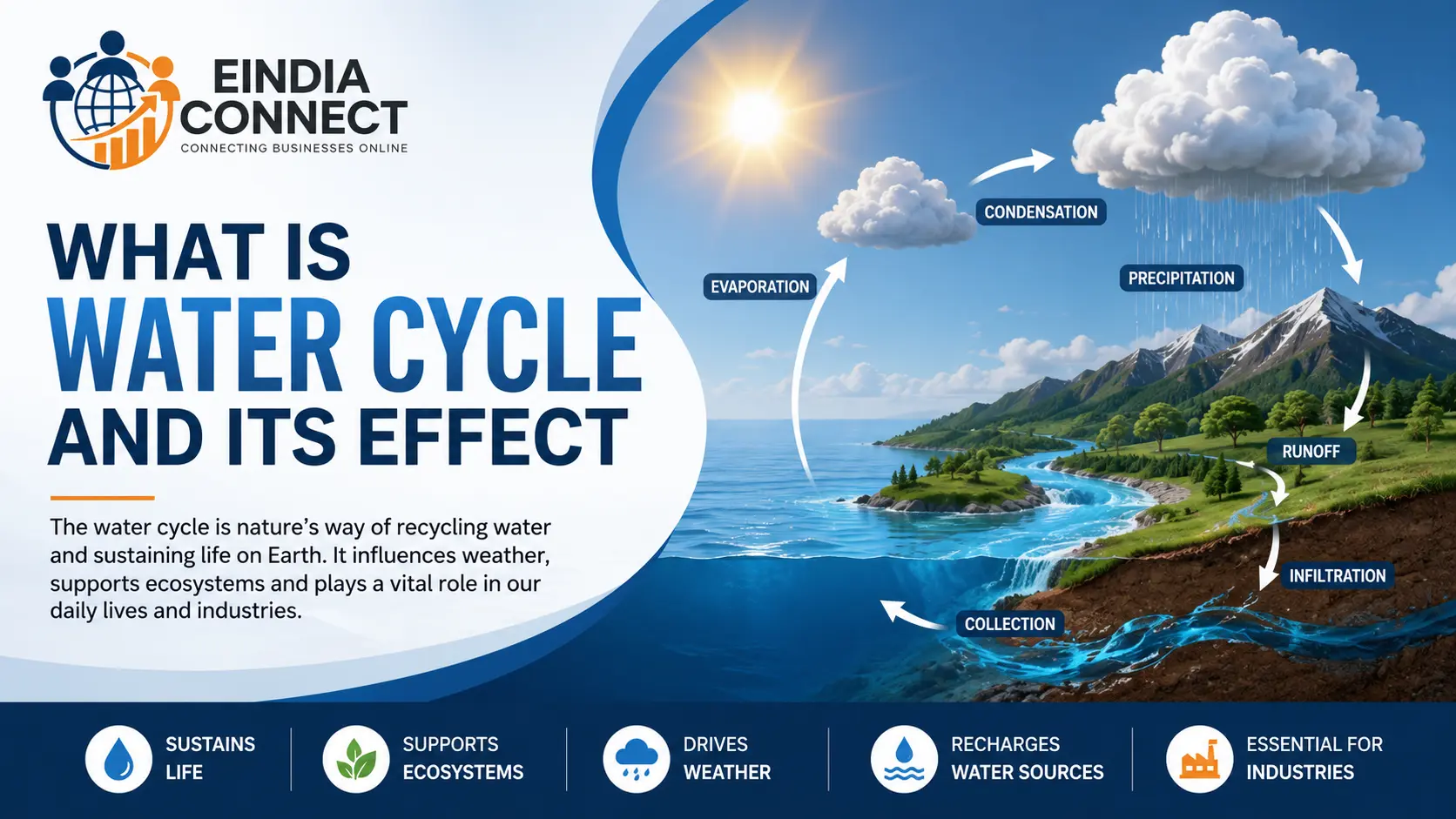
What is Water Cycle and Its Effect?
Water is one of the most essential resources on Earth. Every living organism, from humans and animals to plants and microorganisms, depends on water for survival. However, water does not remain in one place. It continuously moves between the atmosphere, land, oceans, rivers, lakes, and underground reservoirs through a natural process known as the water cycle.
The water cycle is responsible for distributing water across the planet and maintaining the balance of ecosystems. It also influences weather patterns, climate conditions, agricultural productivity, and water availability for industries and communities. As a leading B2B portal and marketplace, E India Connect shares valuable information on environmental sustainability, water management, industrial technologies, and related sectors. Understanding the water cycle is particularly important for businesses involved in water treatment, rainwater harvesting, wastewater management, agriculture, and environmental services.
In this blog, we will explore detailed water cycle information, understand its stages, learn about its effects on the environment and weather, and discover why it is important for both nature and industry.
What is the Water Cycle?
The water cycle, also called the hydrological cycle, is the continuous circulation of water between the Earth's surface and the atmosphere. This natural process ensures that water is constantly recycled and redistributed across the planet.
When discussing about water cycle, it is important to understand that water can exist in three forms—liquid, solid, and gas. Throughout the cycle, water continuously changes between these forms while moving through different parts of the environment.
The cycle water cycle process has existed for billions of years and plays a vital role in maintaining life on Earth. Without it, freshwater resources would become depleted, and ecosystems would struggle to survive.
Why is the Water Cycle Important?
The water cycle is much more than a natural phenomenon. It is the system that keeps water available for humans, animals, plants, and industries.
Some of the major benefits of the water cycle include:
- Replenishing freshwater resources
- Supporting agriculture and food production
- Maintaining rivers, lakes, and wetlands
- Regulating climate and weather patterns
- Recharging groundwater reserves
- Sustaining biodiversity and ecosystems
Without the continuous movement of water through the environment, many regions would experience severe water shortages.
Water Cycle Information: Understanding the Main Stages
The water cycle consists of several interconnected stages that continuously repeat themselves.
Evaporation
The process begins with evaporation. Heat from the sun causes water from oceans, rivers, lakes, ponds, and reservoirs to transform into water vapor. This vapor rises into the atmosphere and becomes part of the Earth's moisture system.
Oceans contribute the largest amount of evaporated water because they cover more than 70% of the Earth's surface.
Transpiration
Plants also play an important role in the water cycle through transpiration. During this process, plants absorb water through their roots and release water vapor through tiny pores in their leaves.
Together, evaporation and transpiration supply a significant amount of moisture to the atmosphere.
Condensation
As water vapor rises higher into the atmosphere, temperatures decrease. The vapor cools and condenses into tiny water droplets. These droplets combine to form clouds.
Condensation is a critical stage in the cycle of weather because cloud formation directly affects rainfall and other weather events.
Precipitation
When cloud droplets become too heavy, they fall back to Earth as precipitation. Depending on atmospheric conditions, precipitation may occur as rain, snow, sleet, or hail.
This stage returns water to the Earth's surface and replenishes natural water resources.
Infiltration and Groundwater Recharge
After precipitation reaches the ground, some water seeps into the soil through a process known as infiltration. This water eventually reaches underground aquifers and becomes groundwater.
Groundwater serves as an important source of drinking water and industrial water supply in many regions.
Surface Runoff
Not all rainwater enters the soil. A portion flows over the land surface and enters rivers, streams, and lakes. This movement of water is known as runoff.
Eventually, runoff carries water back to oceans and large water bodies, where the cycle begins again.
Describe About Water Cycle in Simple Terms
To describe about water cycle in simple language, it can be understood as nature's way of recycling water.
The sun heats water and causes it to evaporate. The water vapor rises into the atmosphere and forms clouds through condensation. These clouds eventually release precipitation, which returns water to the Earth's surface. The water then collects in rivers, lakes, oceans, and underground reservoirs before starting the cycle again.
This continuous process ensures that water remains available for all living organisms.
Different Types of Water Cycle
Scientists often classify the water cycle into different categories based on the path water takes through the environment.
Short Water Cycle
In the short water cycle, water evaporates from the ocean, forms clouds, and falls back into the ocean without reaching land.
Medium Water Cycle
In this cycle, water evaporates from oceans, forms clouds, and falls as rain on land. Rivers and streams then transport the water back to the ocean.
Long Water Cycle
The long water cycle involves glaciers, ice caps, groundwater storage, and snowfields. Water may remain stored for years or even centuries before re-entering the atmosphere or oceans.
These different types of water cycle help maintain water distribution across various regions of the Earth.
Example of a Water Cycle
An example of a water cycle can be observed during the monsoon season.
Water from oceans evaporates due to solar heat and rises into the atmosphere. As the vapor cools, clouds form. Winds carry these clouds toward land, where they release rainfall. Some rainwater enters rivers and lakes, while some infiltrates into the soil and becomes groundwater. Rivers eventually transport the water back to the oceans, where evaporation begins again.
This example demonstrates how water continuously circulates throughout nature.
Effect of the Water Cycle on Weather and Climate
The water cycle has a direct impact on weather systems and climate patterns around the world. The movement of moisture through evaporation, condensation, and precipitation helps determine humidity levels, cloud formation, and rainfall distribution.
Some major effects of the water cycle on weather include:
- Formation of clouds and rainfall
- Regulation of atmospheric moisture
- Development of storms and weather systems
- Influence on temperature patterns
- Distribution of freshwater resources
Because of its strong connection with the atmosphere, the water cycle is often considered one of the most important drivers of the Earth's weather systems.
Importance of the Water Cycle for Industries
The water cycle is not only important for nature but also for various industries. Water is required in manufacturing, agriculture, power generation, food processing, construction, and wastewater treatment.
Industries that particularly benefit from a healthy water cycle include:
- Water treatment plants
- Sewage treatment facilities
- Effluent treatment plants
- Agriculture and irrigation sectors
- Rainwater harvesting solution providers
- Environmental management companies
As a trusted B2B portal and marketplace, E India Connect connects businesses with manufacturers, suppliers, and service providers operating in these sectors, helping industries find reliable water management solutions.
Human Impact on the Water Cycle
Human activities can significantly influence the natural water cycle. Rapid urbanization, deforestation, pollution, and climate change are altering the way water moves through the environment.
Some activities that affect the water cycle include:
- Excessive groundwater extraction
- Deforestation and habitat loss
- Industrial pollution
- Expansion of concrete urban areas
- Greenhouse gas emissions
These factors can lead to reduced groundwater recharge, changes in rainfall patterns, and increased risks of droughts or floods.
Conclusion
The water cycle is one of the most important natural processes on Earth. Understanding water cycle information, learning about water cycle stages, exploring different types of water cycle, and studying an example of a water cycle helps us appreciate how water continuously supports life and industry.
The water cycle influences weather, climate, agriculture, ecosystems, and water availability for communities and businesses. As awareness of water conservation and sustainability continues to grow, understanding this process becomes increasingly important. Through informative industry-focused content, E India Connect aims to help businesses and individuals stay informed about environmental practices, water management technologies, and sustainable industrial solutions.