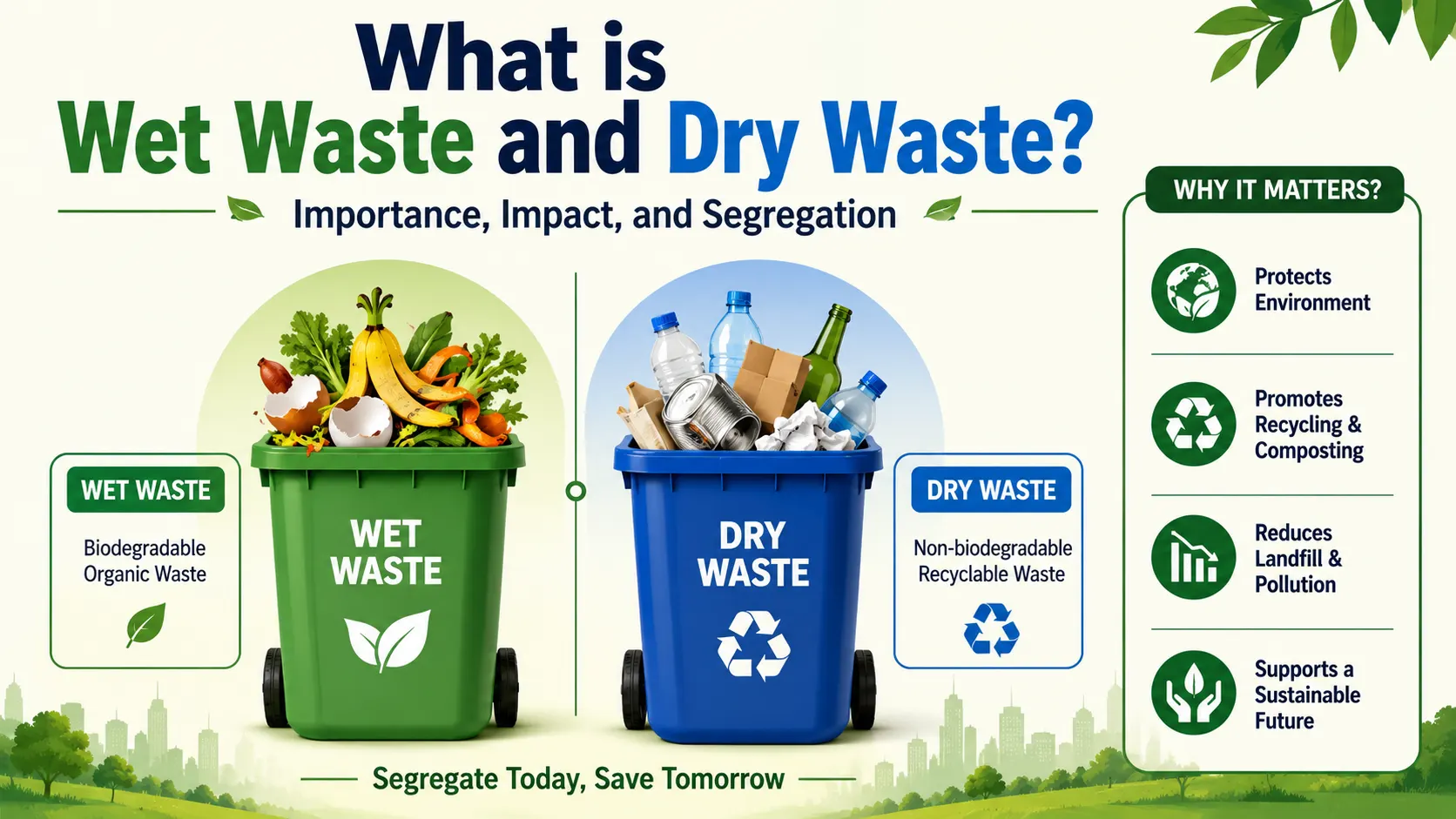
What is Wet Waste and Dry Waste? Importance, Impact, and Segregation
Waste management has become one of the most important environmental concerns in today's world. With rapid urbanization and increasing consumption, the amount of waste generated by households, industries, institutions, and commercial establishments continues to rise. Effective waste management begins with understanding the difference between wet waste and dry waste and ensuring proper segregation at the source.
Proper waste segregation not only helps reduce landfill waste but also promotes recycling, composting, and sustainable waste management practices.
What is Wet Waste?
Wet waste refers to biodegradable waste that decomposes naturally through microbial activity. It generally contains moisture and originates from kitchens, gardens, restaurants, hotels, and food processing facilities.
Examples of Wet Waste
- Fruit and vegetable peels
- Leftover food
- Tea leaves and coffee grounds
- Eggshells
- Garden waste
- Flowers and leaves
- Organic kitchen waste
Since wet waste decomposes quickly, it can be converted into nutrient-rich compost through composting processes.
What is Dry Waste?
Dry waste consists of non-biodegradable or recyclable materials that do not decompose easily. These materials can often be collected, sorted, and recycled into new products.
Examples of Dry Waste
- Paper and cardboard
- Plastic bottles and containers
- Glass bottles
- Metal cans
- Packaging materials
- Rubber products
- Textiles
Proper segregation of dry waste helps improve recycling efficiency and reduces environmental pollution.
Importance of Waste Segregation
Reduces Landfill Burden
Separating wet and dry waste minimizes the amount of waste sent to landfills, extending landfill lifespan and reducing environmental impact.
Promotes Recycling
Dry waste can be effectively recycled into new products, conserving natural resources and reducing energy consumption.
Supports Compost Production
Wet waste can be converted into organic compost, which can be used as a natural fertilizer for agriculture and landscaping.
Improves Waste Collection Efficiency
Segregated waste is easier to collect, transport, process, and manage compared to mixed waste.
Protects the Environment
Proper waste segregation reduces pollution, greenhouse gas emissions, and contamination of soil and water resources.
Environmental Impact of Improper Waste Management
When wet and dry waste are mixed together, several environmental problems arise:
- Increased landfill waste
- Methane emissions from decomposing organic waste
- Soil and groundwater contamination
- Reduced recycling efficiency
- Higher waste processing costs
- Increased air pollution from waste burning
Effective segregation at the source is one of the simplest ways to address these challenges.
Waste Management Machines for Efficient Waste Processing
Modern waste management systems rely on advanced machinery to improve waste handling, recycling, and compost production.
Composting Machines
Composting machines are designed to convert organic wet waste into nutrient-rich compost in a controlled environment. These machines accelerate the decomposition process, reduce waste volume, eliminate odors, and produce valuable organic fertilizer. They are widely used in housing societies, hotels, institutions, restaurants, and industrial facilities.
Benefits of Composting Machines
-
Faster compost production
-
Reduced landfill waste
-
Environment-friendly waste disposal
-
Production of organic manure
-
Lower waste transportation costs
Shredder Machines
Shredder machines play a vital role in waste processing by reducing the size of various waste materials. They are used for shredding plastic, paper, cardboard, organic waste, and other recyclable materials before further processing.
Benefits of Shredder Machines
-
Reduces waste volume
-
Improves recycling efficiency
-
Facilitates composting operations
-
Simplifies waste handling and transportation
-
Enhances overall waste processing efficiency
Organic Waste Converters
Organic waste converters are used to process food waste and biodegradable materials into compost quickly and efficiently. These systems are widely adopted in commercial and municipal waste management projects.
Recycling Equipment
Various sorting and recycling machines help separate and process recyclable dry waste materials such as plastic, paper, metal, and glass, supporting circular economy initiatives.
Best Practices for Waste Segregation
- Use separate bins for wet and dry waste.
- Educate households and employees about waste segregation.
- Avoid mixing recyclable and biodegradable waste.
- Compost organic waste whenever possible.
- Send recyclable materials to authorized recycling facilities.
- Utilize waste management equipment for efficient processing.
E India Connect: Your Trusted B2B Marketplace for Waste Management Solutions
Businesses, municipalities, housing societies, and institutions looking for reliable waste management equipment can explore E India Connect, a leading B2B portal and marketplace. The platform helps buyers connect with verified manufacturers and suppliers of composting machines, shredder machines, organic waste converters, waste segregation systems, recycling equipment, and other waste management solutions.
E India Connect simplifies the sourcing process by enabling businesses to compare products, request quotations, and connect directly with trusted suppliers across India. Whether you are planning a small-scale waste management project or a large industrial waste processing facility, E India Connect serves as a valuable marketplace for finding the right waste management equipment and service providers.
Conclusion
Understanding the difference between wet waste and dry waste is the foundation of effective waste management. Proper segregation helps reduce landfill waste, improve recycling rates, support compost production, and protect the environment. With the use of modern waste management equipment such as composting machines, shredder machines, and organic waste converters, organizations and communities can efficiently process waste and contribute to a cleaner and more sustainable future.